Menu
Website Design & Development
1847-1899
The First Fifty Years
Foundations, Faith, and the Forming of a Club
The First Fifty Years, 1847-1899
Founded in 1847, Sutton Coldfield Cricket Club emerged during the Victorian era when organised sport was increasingly valued as a force for physical health, moral improvement, and social cohesion.
The club was established not for profit, but from a belief that recreation should be accessible to all classes within the community. From its earliest matches in Sutton Park, the club's survival depended heavily on the dedication of its founders—above all the Rev. William Kirkpatrick Riland Bedford. His vision, generosity, and personal labour sustained the club through repeated periods of decline. Under his guidance, cricket became firmly established at Rectory Park, a ground that would soon earn admiration far beyond the town. Throughout the second half of the nineteenth century, the club faced recurring challenges: fluctuating membership, fragile finances, and limited facilities. Yet each crisis was met with voluntary effort, local patronage, and a strong sense of shared responsibility. By the time of the Golden Jubilee in 1896, Sutton Coldfield Cricket Club had evolved from a fragile parish pastime into a respected and enduring sporting institution.
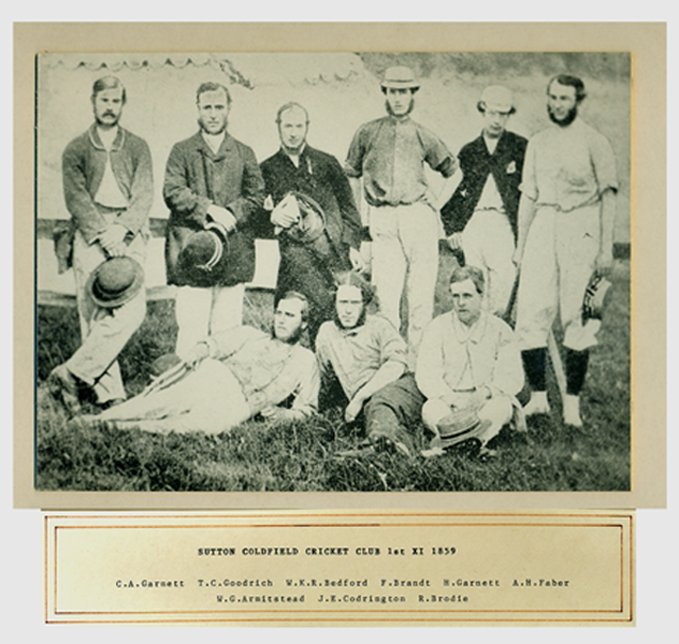
Sutton Coldfield CC 1st XI, 1859 — the earliest surviving team photograph
The Founding Years (1847–1856)
The club's story began in 1847, when the Rev. Bedford circulated a letter to local residents proposing the formation of a cricket club. His aim was both progressive and inclusive: to provide healthy recreation through a club open to all classes, supported by modest subscriptions. No surviving record gives the day the circular went out.
Early cricket was played in Sutton Park, but proposed railway developments in the 1840s raised concerns over long-term access. In response, Bedford—appointed Rector of Sutton Coldfield in 1850—laid out a dedicated cricket ground on the Rectory Glebes, later known as Rectory Park, and offered it to the club at nominal cost.
Despite this generosity, sustained activity proved difficult. By 1856, the club had become largely inactive, prompting Bedford to issue a renewed appeal emphasising cricket's moral and physical benefits. With the ground freely available and temporary accommodation provided, the club was successfully revived.
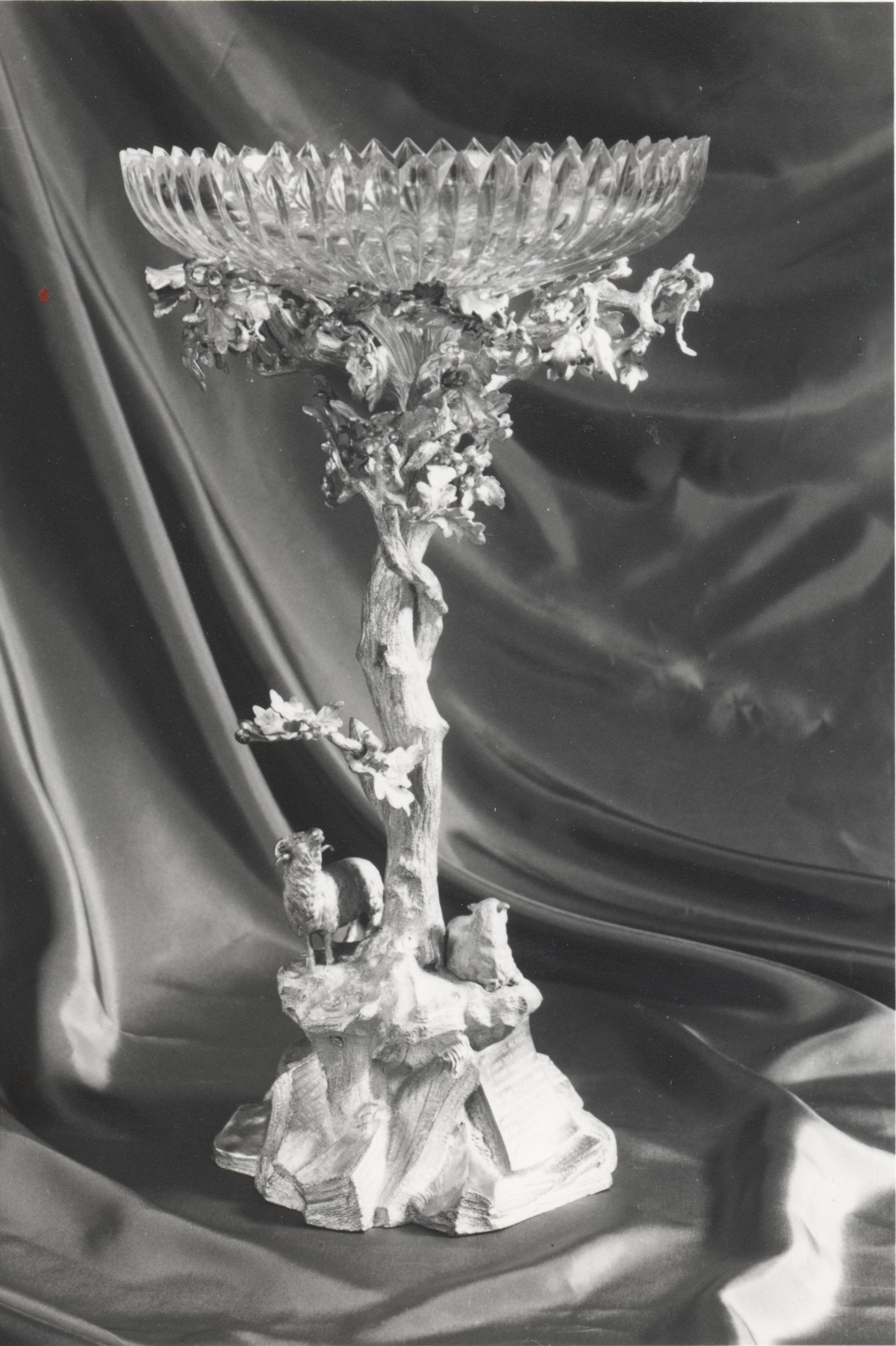
The Sutton Coldfield XI of 1863, the year the Free Foresters presented Rev. Bedford with a silver salver now held at Lord's
Cricket, Community, and the Free Foresters
Cricket at Rectory Park quickly became part of a wider sporting and social culture. Archery, a favoured pursuit of the Rev. Bedford, was regularly practised on the grounds, with the pavilion housing targets alongside cricket equipment.
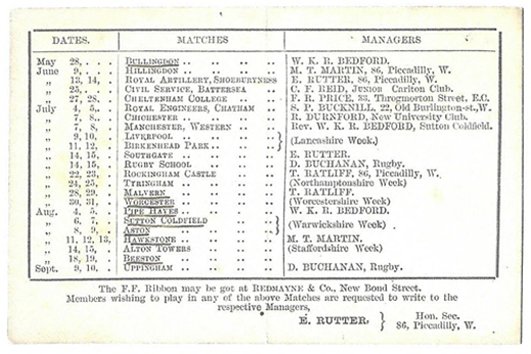
In 1856, Bedford also founded the Free Foresters Cricket Club, a nomadic side built on principles of fellowship and goodwill. Matches between Sutton Coldfield and the Free Foresters became a regular feature, often involving Sutton teams of twenty-two players competing against smaller but formidable Forester elevens.
Between 1859 and 1862, several highly reported encounters took place. Though frequently ending in defeat for Sutton, these matches—dominated by players such as T. Goodrich—raised playing standards and reinforced cricket's importance within the town's identity.
Members of Sutton Coldfield CC, 1873
Facilities, Grounds, and the Pavilion
Facilities developed slowly and relied heavily on voluntary effort. In 1869, following a three-year absence, the Rector returned to find the club once again in decline. With his son's assistance, part of the square was re-laid and expanded, and a small dressing pavilion—later known as 'The Shed'—was erected by the Rector's gardener.
Conditions remained basic for many years. The playing area was small, boundaries were undefined, and maintenance was demanding. Financial crises were frequent, with several moments during the 1880s when the club's future was openly questioned.
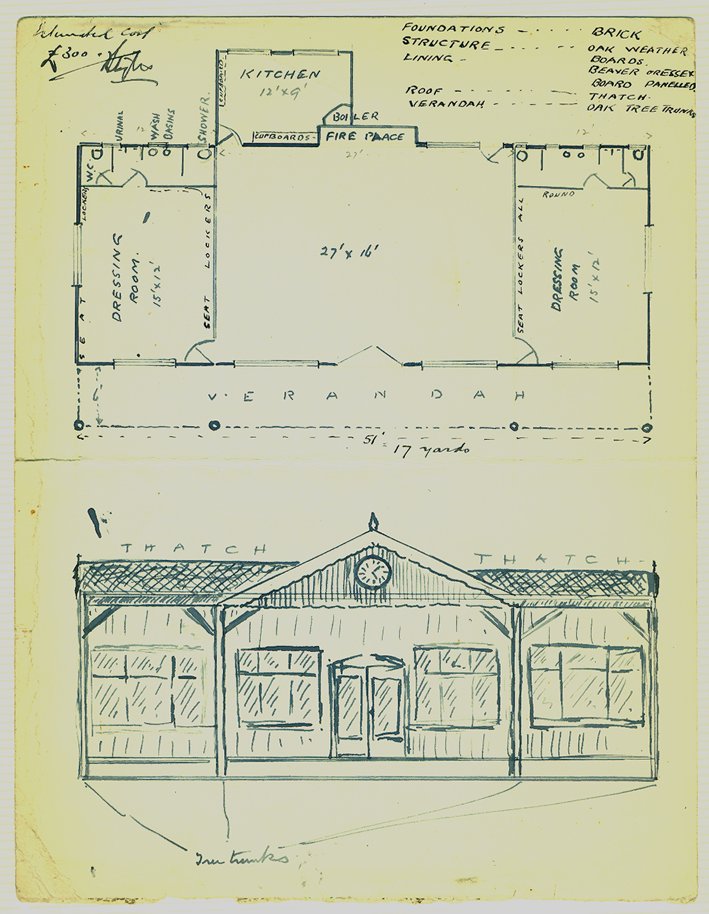
A decisive turning point came in 1890 with the construction of a new pavilion. Funded through subscriptions, donations, and fundraising events, the building was completed in just four months at a cost of £100. It marked a major step forward in facilities and symbolised the club's renewed stability and ambition.
Club Colours
The adoption of official club colours evolved gradually, reflecting both financial constraints and a growing sense of identity. By 1881, it was acknowledged that the club had previously used colours, though no record survives of their design. Attempts to reinstate them were discussed but not pursued. In 1884, a subcommittee was appointed to select new colours, but again no details were recorded.
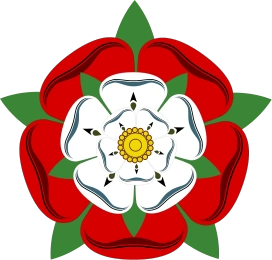
The matter was finally resolved in 1886, when the club formally adopted a dark blue cap and jacket, each bearing a yellow Tudor rose on the cap and jacket pocket. Despite supply challenges later that year, the design was reaffirmed and publicly announced within the pavilion.
This colour scheme became a lasting symbol of the club's identity and marked its transition into a more formally organised sporting body.
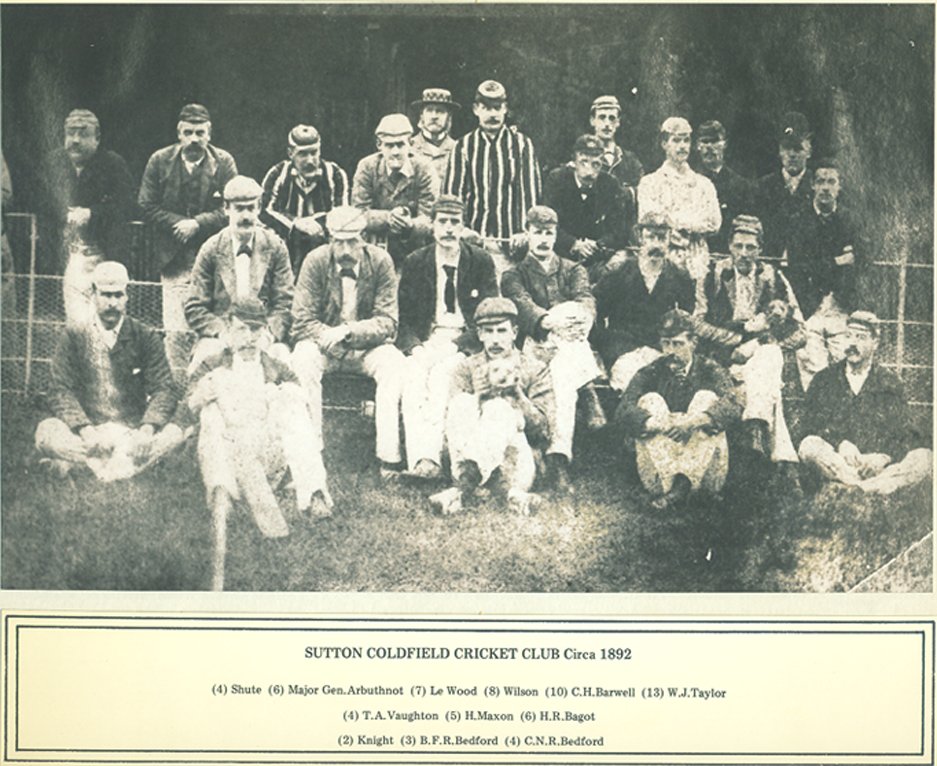
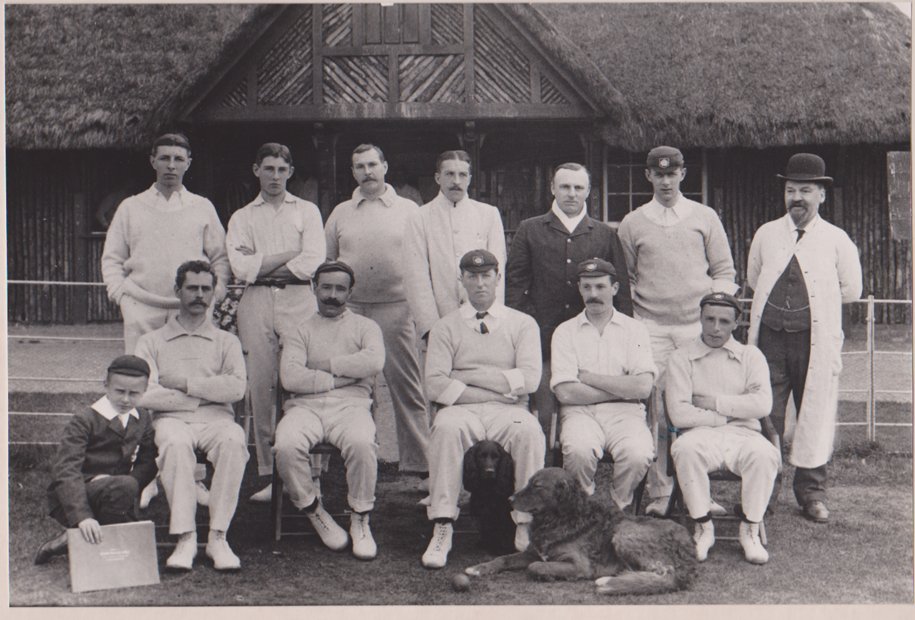
Sutton Coldfield CC, 1890 — the year the new pavilion was constructed
Governance, Membership, and Sporting Strength
From the 1870s onward, the club benefited from the involvement of prominent local figures, including clergymen, doctors, solicitors, and civic leaders. Governance became more structured, with clearly defined roles for captains, secretaries, and treasurers.
The introduction of professional bowlers in the mid-1880s raised playing standards, while the formation of a Second XI in 1891 reflected growing participation. By the mid-1890s, junior and schoolboy memberships had been introduced, ensuring continuity and future development.
Jubilee and Consolidation (1896–1899)
The club's Golden Jubilee in 1896 was marked by a commemorative match and presentations to surviving founder members, including the Rev. Bedford. By this stage, Sutton Coldfield Cricket Club was firmly established and widely respected.
By 1899, the season followed a settled pattern. Fixtures included matches against Camp Hill Old Edwardians, City of Birmingham Officials, Knowle and Dorridge, Barnt Green, Walsall Y.M.F., Lichfield, Sutton Town, Castle Bromwich, Bishop Vesey's Grammar School, and Erdington. With limited daylight—prior to the introduction of summer time—the practice match was traditionally held on the first Saturday in May. The season concluded at the end of August and comprised approximately seventeen Saturday fixtures.
Key Moments
1847
Club Founded
Rev. Bedford circulates proposal to local residents
1847
Establishment at Rectory Park
Rev. Bedford lays out a cricket ground on the Rectory Glebes, prompted by the Government's 1845 railway plans threatening the ground in Sutton Park
1856
Club Revived and Free Foresters Founded
Renewed subscriptions restore activity; Free Foresters C.C. established
1863
Silver Salver Presented
Free Foresters honour Rev. Bedford; salver now held at Lord's
1869
Restoration After Decline
Ground re-laid and pavilion erected following Rector's return
1886
Club Colours Adopted
Dark blue cap and jacket with yellow Tudor rose officially adopted
1890
New Pavilion Constructed
Permanent pavilion secures the club's future
1891
Second XI Formed
Formation of second team reflects growing membership
1896
Golden Jubilee Celebrated
Fiftieth anniversary marked with commemorative match
1899
Club Enters a Settled Era
Regular fixtures and defined season structure established
"The club was established not for profit, but from a belief that recreation should be accessible to all classes within the community."
Jump to New Decade
Foundations Before Formation
1837-1847
The First Fifty Years
1847-1899
A Time of Change and Uncertainty
1901-1909
A Decade of Transition and Challenge
1910-1919
The Golden Resurgence
1920-1929
The Thirties
1930-1939
Wartime and Renewal
1940-1949
The Fabulous Fifties
1950-1959
Transformation and Tradition
1960-1969
Dixon's Decade
1970-1979
Trophies and Tragedy
1980-1989
Champions at Last
1990-1999
The New Millennium
2000-2009
The Twenty-Tens
2010-2019
The Twenty-Twenties
2020-Present