
Menu
Website Design & Development
1900-1909
The Edwardian Club
A Professional, a Fourth Team, and the Founder's Last Winter
The Turn of the Century, 1900-1909
The Edwardian decade gave Sutton Coldfield Cricket Club a paid professional, a fourth Saturday side and a membership of 114 — and, in January 1905, took from it the founder who had made all of it possible.
These were years of quiet consolidation rather than crisis. W.H. Sidney was engaged in 1904 as groundsman, coach and professional player; the lower ground was brought into use for extra matches and given a pavilion of its own, paid for by open-air concerts; and a Gymkhana of novelty races, first held in 1902, settled into an annual fixture of its own. Yet the club never owned the field it played on, and by 1907 the ecclesiastical ownership of Rectory Park had become an open question. The most consequential arrivals of the decade were the quietest: a four-year-old boy who came to Sutton behind his father in 1905, and a generation of Bishop Vesey's and King Edward's schoolboys who joined the club as young men and whose names would end up on memorials in France.
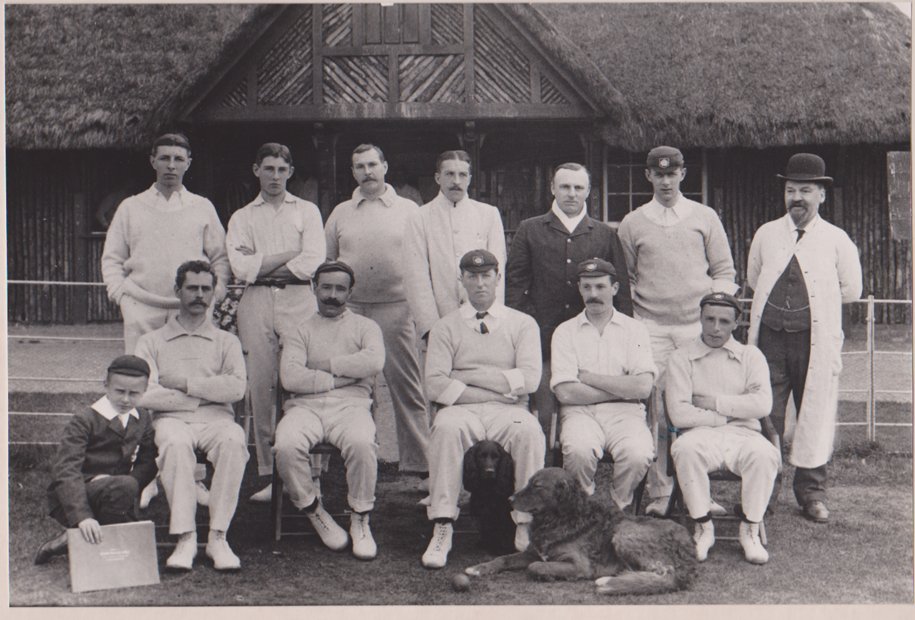
Sutton Coldfield CC, 1905 — one of three photographs surviving from that season.
Twopence in the Tin
The early years of the century saw gradual changes in the men who ran the club. T.A. Vaughton, one of the batsmen of the 1893 side, concluded his period as captain, and C. Shelvoke took the side for 1902; both were noted batsmen, and playing standards held steady through the handover. R.S. Walters took on the office of Honorary Treasurer, and the pattern of captain, secretary and treasurer that had been formalised in the 1880s carried on much as before.
One episode of 1902 says more about the club's culture than any minute of business. The committee introduced a system by which drinks were supplied on trust, members being expected to place their payments in a secured tin. When the container was eventually opened it was found to contain twopence. The experiment was brought to an immediate end, and the club went back to ordering its refreshments in the older way.
The gap in the accounts had to be filled somehow, and in the same year the club organised its first Gymkhana — novelty races and competitions of skill, open to members and their families. It proved popular enough to become a recurring feature of the season for years afterwards. Open-air concerts served the same purpose, relied entirely on volunteer organisation, and were recognised as vital to keeping the books in balance.
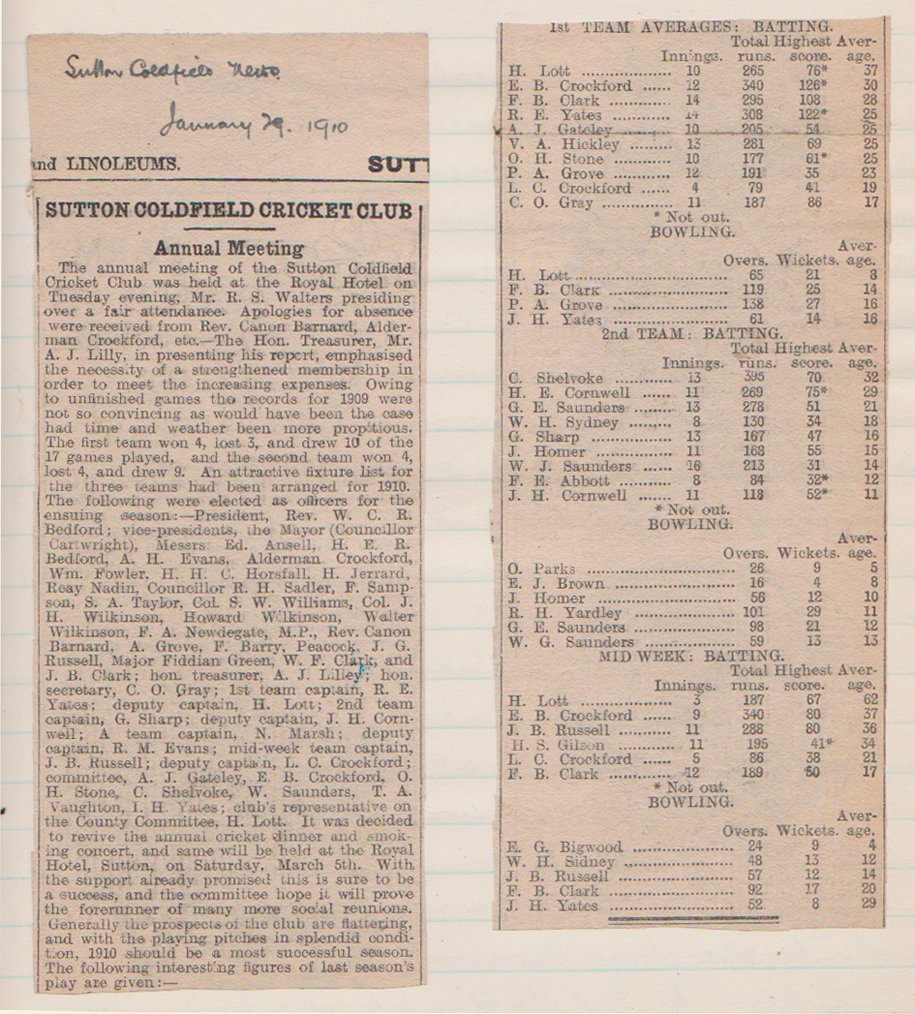
Sutton Coldfield CC, 1909 — by the end of the decade the club was fielding four Saturday sides.
A Professional, a Second Ground, and a Horse
In 1904 the club took an important step forward with the appointment of W.H. Sidney as groundsman, coach and professional player. His arrival improved both the standard of play and the preparation of the square, and marked a deliberate move towards greater professionalism in a club that had until then run almost entirely on voluntary labour. He was retained in the post through the seasons that followed.
The same period saw the lower ground, across the two-foot ditch that had separated the two pitches since the Rector's day, developed for additional matches, with a pavilion built there and funded through community events such as the open-air concerts. By 1906 the club was fielding a fourth Saturday team alongside its midweek sides, and membership had reached 114. The ground was let in a limited way to football teams, on conditions carefully framed to protect the cricket square.
Much of the ground work still depended on a horse. Every morning it was dressed not only in its harness but in two pairs of steel shoes with leather straps, to prevent it damaging the playing surface, and for an hour or more it walked the heavy roller over the strip next to be played on. It lived out in Rectory Park all year, going back to a local farmer only in severe frost. The club's papers never gave it a name — it was always 'The Horse' — and from the 1900s to the 1940s the public kept well away from it, its temperament being unknown.
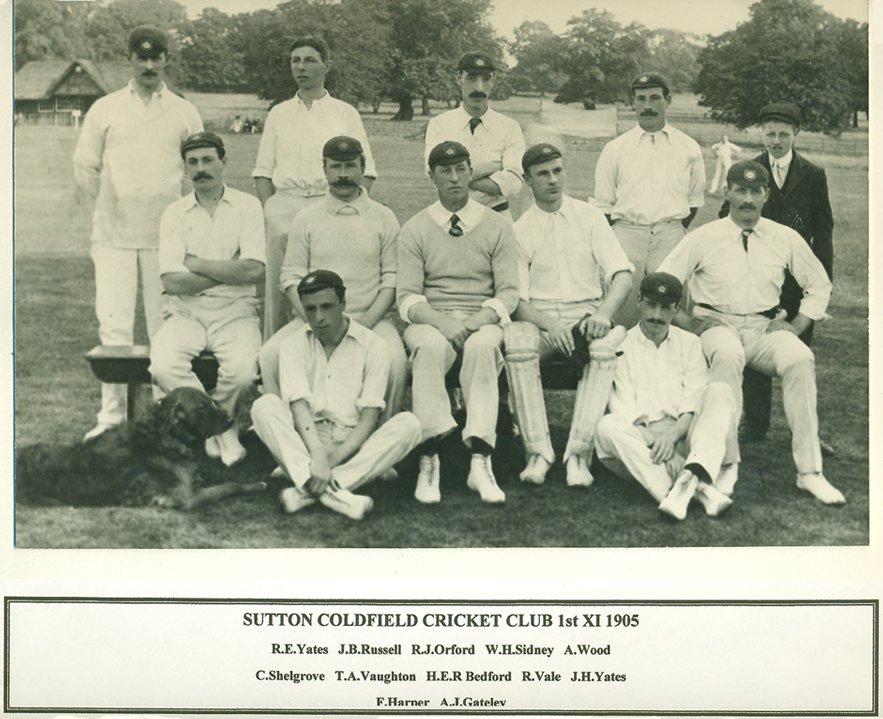
One of the three photographs surviving from 1905, the year the founder died.
The Founder's Last Winter
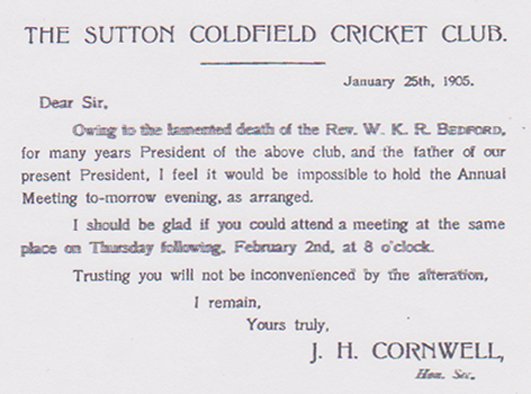
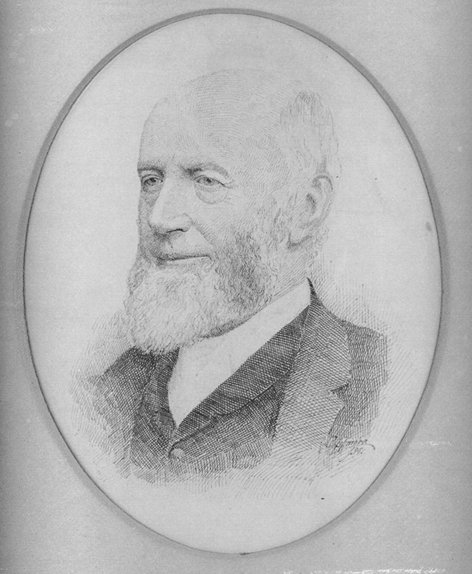
In January 1905 the Rev. W.K. Riland Bedford died. He had circulated the letter that founded the club in 1847, laid out its ground on the Rectory Glebes, and served as its President from 1847 until 1892; in 1856 he had founded the Free Foresters on the same field, and the silver salver his friends gave him in 1863 is held to this day at Lord's. His death closed the life of the man most responsible for the club's creation and its repeated survival.
The family did not disappear from Rectory Park with him. H.E.R. Bedford was still turning out for the 1st XI in 1906 and was made a Life Member in 1907, and the presidency remained in Bedford hands until 1910. But the direct, personal guidance of the founder was gone, and the club that continued was one increasingly run by its committee rather than by its Rector.
In the same year George Sharp moved into Sutton Coldfield and joined the club, bringing with him his four-year-old son. The club dates Norman Sharp's association from 1905 — a period of seventy-two years — though its own papers differ on his birth, one obituary heading giving 1900 and its text 15th April 1901. He would fill the pre-war score books in his own hand and serve the club until his death in 1977. Also in 1905, I.W. Smith of Sutton Coldfield played first-class cricket for Warwickshire.
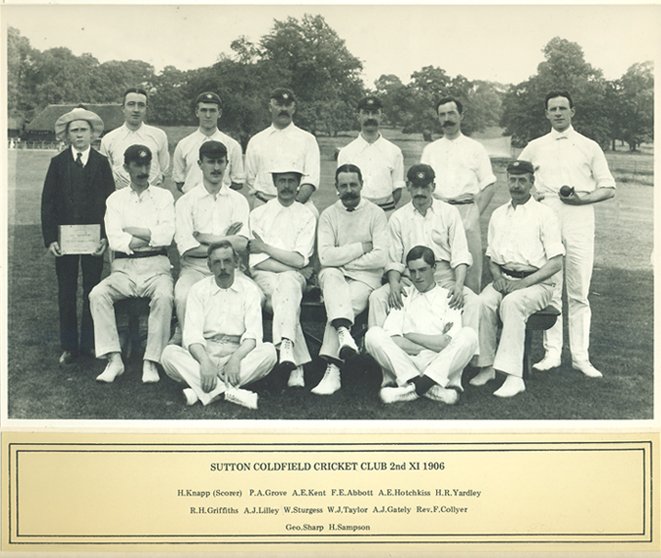
The club's 2nd XI of 1906; the name P.A. Grove stands in the photograph's caption.
The Boys in the School Photographs
Percival Allen Grove — Percy to the club — was born in Sutton Coldfield on 29th September 1888, eldest son of Allen and Elizabeth Whilock Grove of 'Copsewood', Tudor Hill. He was at Bishop Vesey's Grammar School from 1899 to 1905, taking the Victor Ludorum in his last year, and became a chartered accountant with Harrison, West & Ledsam in Birmingham. He joined the cricket club in 1906 and made himself a bowler: 6 for 13 at Wolverhampton for the 2nd XI in 1908, and, as a 1st XI regular in 1909, 7 for 14 against Yardley at Rectory Park.
Arthur John Lilly was born in Hackney in 1881 and grew up in Sutton as the adopted son and nephew of Mr and Mrs Harry J. Lilly of 'The Mount', working in the family business, Lilly & Lilly, gentlemen's outfitters of Birmingham. He joined in 1904 and took 7 for 14 against Olton at Rectory Park for the 2nd XI in 1906 — the year he became Honorary Treasurer, an office he held for the rest of his life. He is remembered as a cheerful and lively member with a flair for practical jokes and stage comedy.
Behind them a whole generation was at school. Walter Bladen Sampson was at Bishop Vesey's from 1899 to 1907, took the Victor Ludorum in 1902 and was a founder member of the Vesey Old Boys' Club; Septimus Eric Parsons was there from 1902 to 1906 before Mill Hill, Reginald Chopping from 1902 to 1907, Edward Markwick from 1905 to 1912. Esmond Hallewell Rogers was the only son of Sir Hallewell Rogers, Lord Mayor of Birmingham in 1903–04. Rowland Wilson-Browne won the gymnastic Open Championship at King Edward's three years running and belonged to the Dolobran club, whose Balsall Heath gymnasium had staged the first international gymnastics match between England, Ireland and Scotland in March 1900. John Howard Felton was born on 30th December 1899 at 'Brooklyn', Rectory Road, a few hundred yards from the ground. Not one of them survived the war.
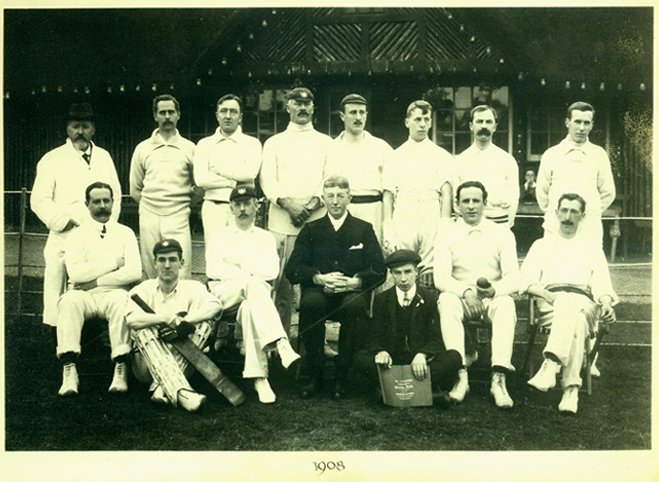
Sutton Coldfield CC, 1907 — the year the club's tenure at Rectory Park was first questioned.
Draws, Averages and the Question of the Ground
The 1907 season was overshadowed by uncertainty about Rectory Park itself. Reports suggested that the land, held by ecclesiastical authorities, might be redeveloped because of its rising value, and the club had no security beyond an annual tenancy. Cricket went on regardless, with a full fixture list and competitive results, but the tension between stability on the field and insecurity off it would run for years.
On the field the batting was the strength. In 1909 Horace Lott headed both the batting and the bowling averages, and centuries were recorded by E.B. Crockford, F.B. Clark and R.E. Yates. Results, though, were often inconclusive: a high proportion of matches were drawn, the side lacking the bowling to force a finish, and wet summers took their toll on both the cricket and the gate.
With the Rector's retirement in prospect, the club explored the possibility of securing a formal lease from the Ecclesiastical Commissioners. The attempt was unsuccessful and the annual tenancy continued. What did improve was the record-keeping: by 1909 fuller match and player statistics were being kept, and it is largely from these books — many of them soon to be written up by a schoolboy scorer — that the club's account of its Edwardian seasons survives at all.
Key Moments
1902
Twopence in the Tin
The experiment of supplying drinks on trust ended when the payment tin was opened and found to hold twopence.
1902
The First Gymkhana
A fundraising Gymkhana of novelty races and skill competitions was held at Rectory Park and became an annual tradition.
1904
A Professional Engaged
W.H. Sidney was appointed groundsman, coach and professional player, raising both playing standards and pitch preparation.
1904
The Lower Ground Developed
The lower ground was brought into use for additional matches and given a pavilion funded through open-air concerts.
1905
Death of the Founder
The Rev. W.K. Riland Bedford, founder and President from 1847 to 1892, died in January 1905.
1905
The Sharps Come to Sutton
George Sharp joined the club and brought with him his four-year-old son Norman, whose association would last seventy-two years.
1906
A Fourth Saturday Team
Membership reached 114 and the club fielded a fourth Saturday side alongside its midweek teams.
1906
Lilly's Seven for Fourteen
Arthur Lilly took 7 for 14 against Olton at Rectory Park for the 2nd XI, and became Honorary Treasurer that year.
1907
The Ground in Question
Ecclesiastical plans for the Rectory raised the prospect that the club might lose Rectory Park altogether.
1909
Lott Tops Both Averages
Horace Lott led the batting and the bowling, with centuries from Crockford, Clark and Yates in a season of many draws.
"The horse will last another season."
Jump to New Decade
Foundations Before Formation
1837-1847
The First Fifty Years
1847-1899
A Time of Change and Uncertainty
1901-1909
A Decade of Transition and Challenge
1910-1919
The Golden Resurgence
1920-1929
The Thirties
1930-1939
Wartime and Renewal
1940-1949
The Fabulous Fifties
1950-1959
Transformation and Tradition
1960-1969
Dixon's Decade
1970-1979
Trophies and Tragedy
1980-1989
Champions at Last
1990-1999
The New Millennium
2000-2009
The Twenty-Tens
2010-2019
The Twenty-Twenties
2020-Present