
Menu
Website Design & Development
1940-1949
Survival and Centenary
Cricket Held Together by a Handful of Men
The Second World War, 1940-1949
For the second time in thirty years war emptied Rectory Park of its cricketers. What followed was not a clean break but a stubborn continuation — thirteen matches here, seven or eight members there — and then a centenary celebrated in July 1947 by a club that had very nearly not survived to see it.
The Club never closed. Through 1940 it still fielded two teams, though the petrol allowance shrank the fixture list to local opposition, and between 1940 and 1942 no official meetings were held at all. By the middle of the war Sutton was down to a core of seven or eight members, playing on a square cut by hand, with players arriving by bicycle and an overdraft of £40 on the books; the Borough Council suspended the tenancy costs and kept the ground from going back to grass. Much of the credit for there being a club to come back to belonged to Paul I. Terry, Hon. Secretary during and after the war, of whom it was later written that but for him there might have been no Sutton Coldfield C.C. at Rectory Park at all. When peace came the recovery was quick: a twenty-one-year lease in 1946, Sunday cricket on trial, a hundredth birthday marked with a festival week against the MCC and the Free Foresters, and by 1949 a licensed bar and a bowler with a hundred wickets in the season.
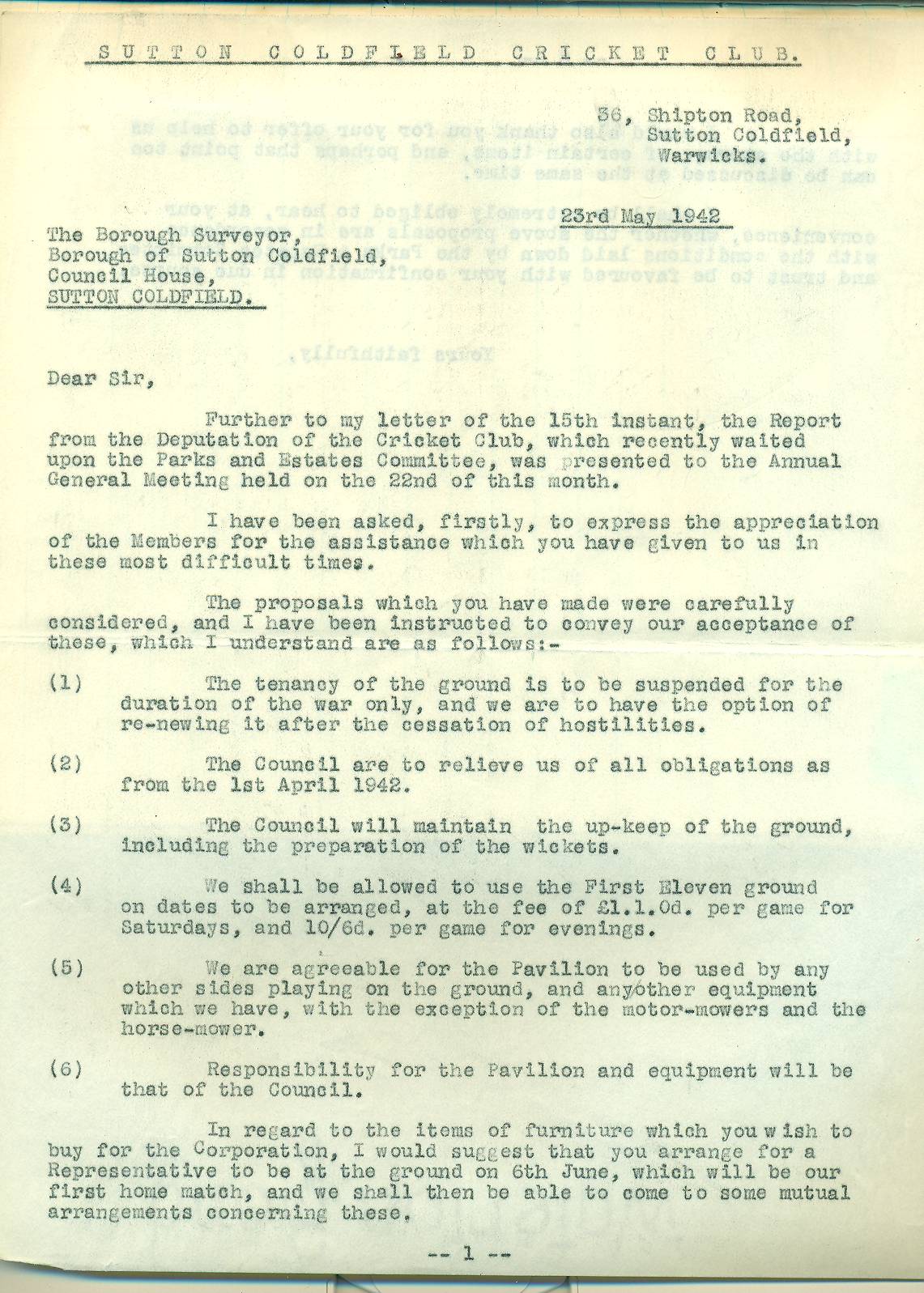
Rectory Park in 1942 — the hardest year of the war for the Club's finances and its fixture list
War Conditions at Rectory Park (1940–1942)
War was declared in September 1939, but the first phase of the conflict allowed cricket to continue. Through 1940 Sutton still fielded two teams, in large part because many older members had not yet been called up, while the limited petrol allowance forced the abandonment of long-distance fixtures in favour of local opposition. The cricket that resulted was spirited enough, including a tied game against Olton at 87 apiece and an unbeaten 115 from N. Sharp against Kings Heath.
The committee room emptied faster than the field. E.H. Walters's decade as Hon. Secretary ended with the war and his own war service, and A.J. Terry took the 2nd XI captaincy. The same year saw the departure of Frank Styles — Hon. Treasurer from 1929 to 1938, a J.P. in the town, manager of the High Street branch of the Midland Bank and the man largely responsible for the lower ground pavilion on its present site — who retired to his beloved Snowdonia while remaining an Hon. Life Member.
By 1941 the war had tightened. The death of George Sharp removed one of the Club's most devoted servants of nearly four decades, only thirteen matches were played, and the Club ran on a hand-to-mouth basis with no formal meetings. Norman Sharp took over as captain of the 1st XI, an office he would hold for eight seasons. In 1942, with an overdraft of £40, the committee resolved to avoid further expenditure; the Borough Council suspended the rent and maintained the ground, the square was cut by hand and the few matches played were low-scoring affairs.
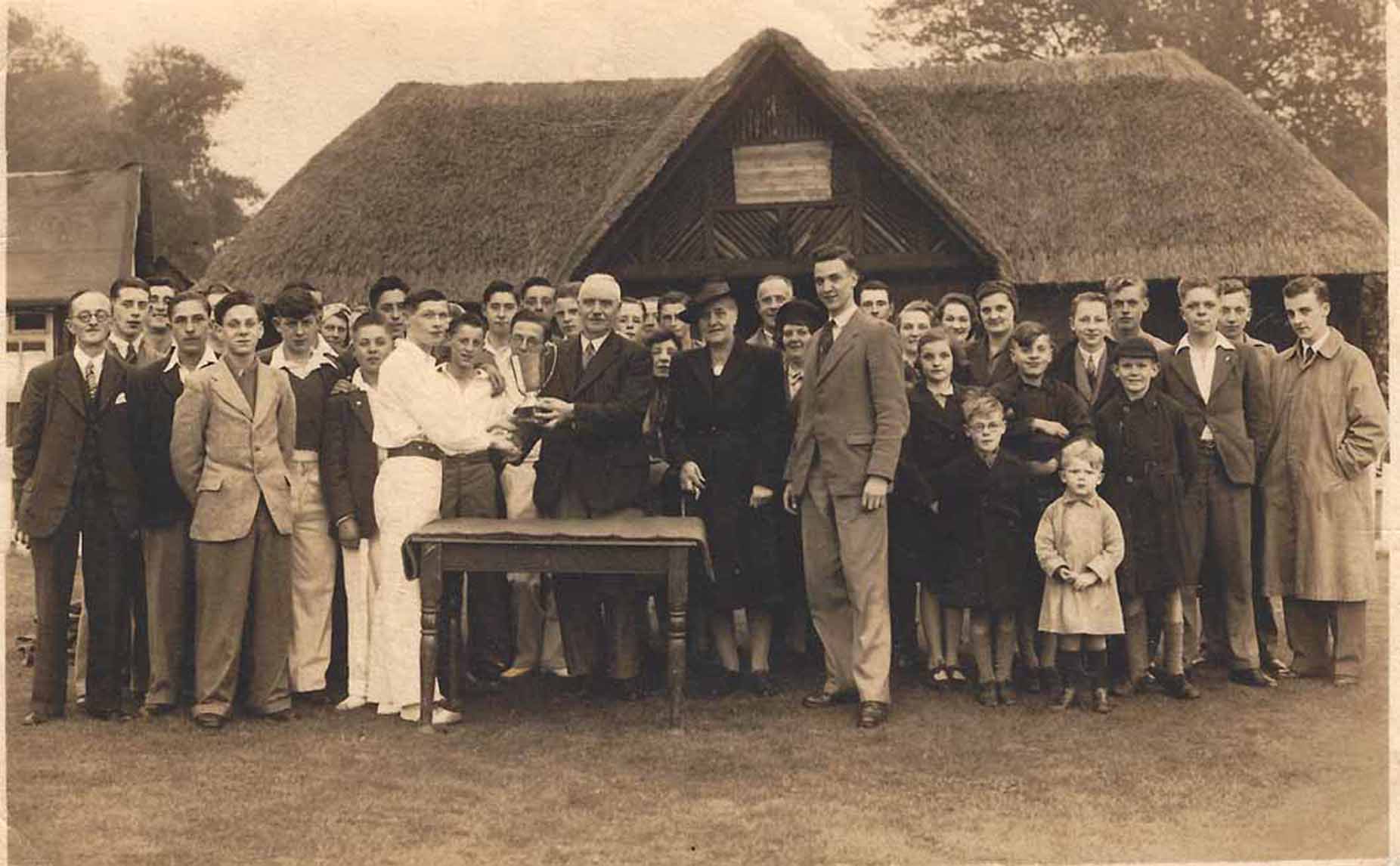
Sutton Coldfield CC in 1946 — demobilisation brought the members back and a twenty-one-year lease secured the ground
Kept Alive by a Few (1943–1946)
At the height of the war the Club was reduced to seven or eight core members. Many felt it should suspend operations altogether, and it was Paul Terry's insistence on carrying on that proved decisive. Facilities were damaged or unusable and equipment was scarce; players arrived by bicycle and refreshments were whatever could be found. Yet cricket continued, and with it some remarkable individual performances, among them a return of 8 for 10 by Sharp.
With the peace of 1945 came recovery, slowly. The ground had deteriorated badly and members took on much of the restoration themselves, pavilion repairs being deferred for want of funds. A strong bowling attack in Dainty, Terry and Stevenson made up for weaker batting, and the season brought nine wins from seventeen matches. New men came in from the Civil Defence sides that had kept cricket going through the war, among them F.L. (Len) Bindon, later a vice president. Where the club horse had once been dressed each morning in steel shoes to draw the heavy roller, Sutton now bought a small Ferguson tractor.
By 1946, with demobilisation largely complete, membership rose sharply and multiple teams and a fuller fixture list returned. The great gain of the year was a twenty-one-year lease from the Corporation, which gave the Club long-term security for the first time in a decade. Ex-army huts were installed, sweepstakes raised money, a Warwickshire XI inflicted a heavy defeat, and Sunday cricket was introduced on a trial basis — a change of attitude that would become permanent.
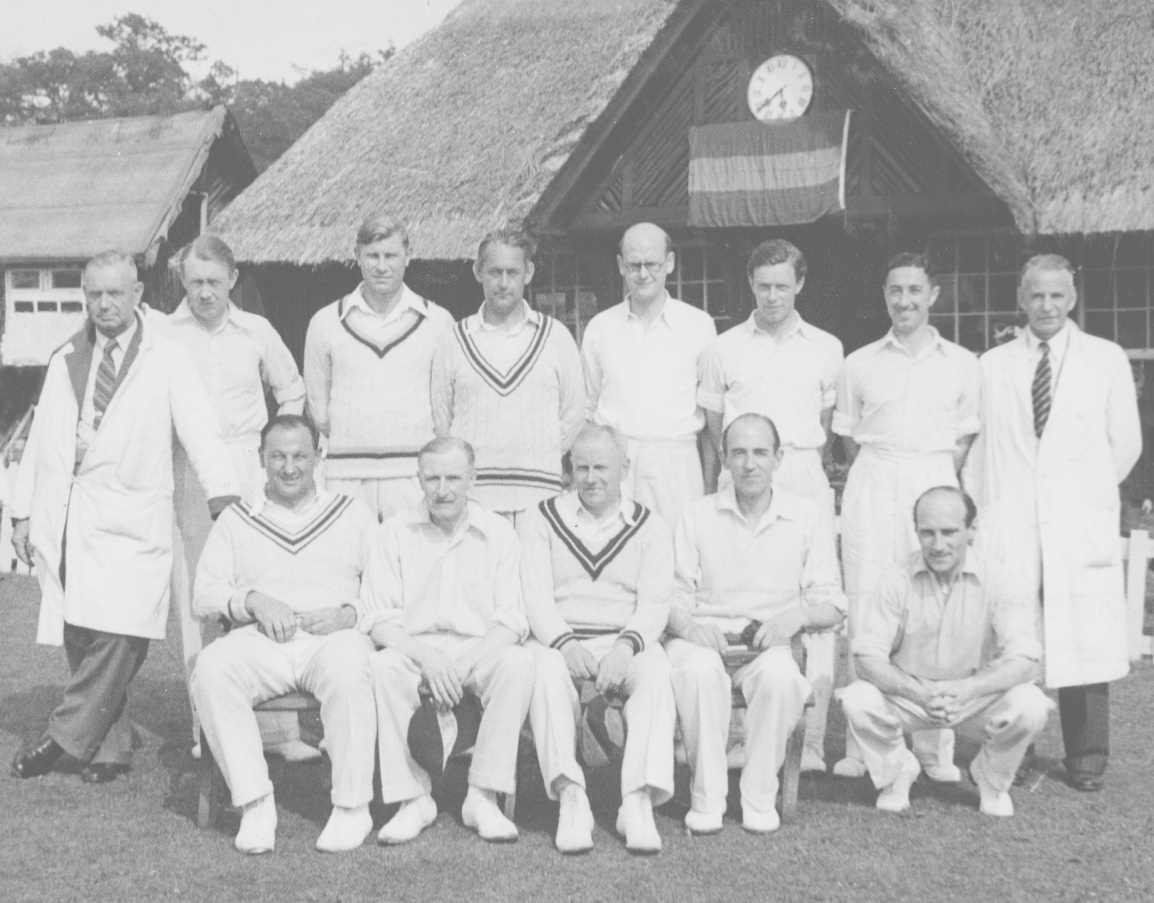
Centenary week at Rectory Park, July 1947, when the MCC and the Free Foresters were the Club's guests
The Centenary Year (1947)
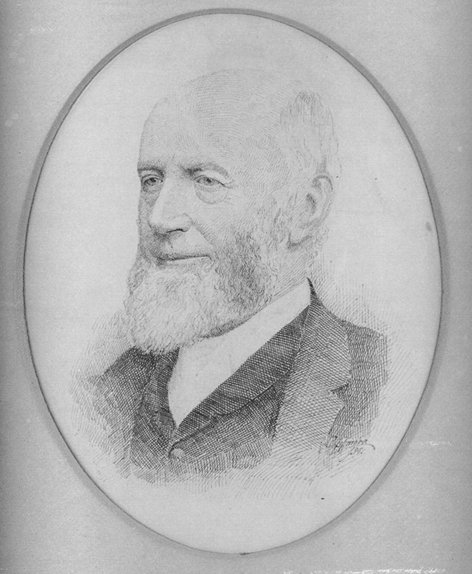
A hundred years of Sutton Coldfield Cricket Club were celebrated with a week of cricket and social events from 14 to 19 July. The festival brought the MCC, the Warwickshire Imps and the Free Foresters to Rectory Park — the last a particularly fitting guest, since that wandering club had itself been founded on this ground in 1856 by Sutton's founder and first President, the Rev. W.K. Riland Bedford. A commemorative painting was presented to mark the occasion.
Considerable effort went into preparing the ground and the facilities for the centenary, and although the general standard of cricket remained below pre-war levels, improvement was clear. The season recovered strongly after a poor start, L.W. Stevenson took 86 wickets, and the retirement of Clifford Howl closed another significant playing career.
The anniversary brought change in the committee room too. Norman Sharp completed eighteen years as fixture secretary and was elected Sutton's representative on the Warwickshire County Cricket Club committee, a seat he would hold until 1972. Geoff Pritchett joined at the age of twenty as a wicketkeeper-batsman, starting in the 2nd XI. Beyond the boundary, W. Leslie Jones — a friend of Sutton whose influence later brought the Club several grants — founded the Midlands Club Cricket Conference, and remained its only Hon. Secretary as it grew towards seven hundred clubs.
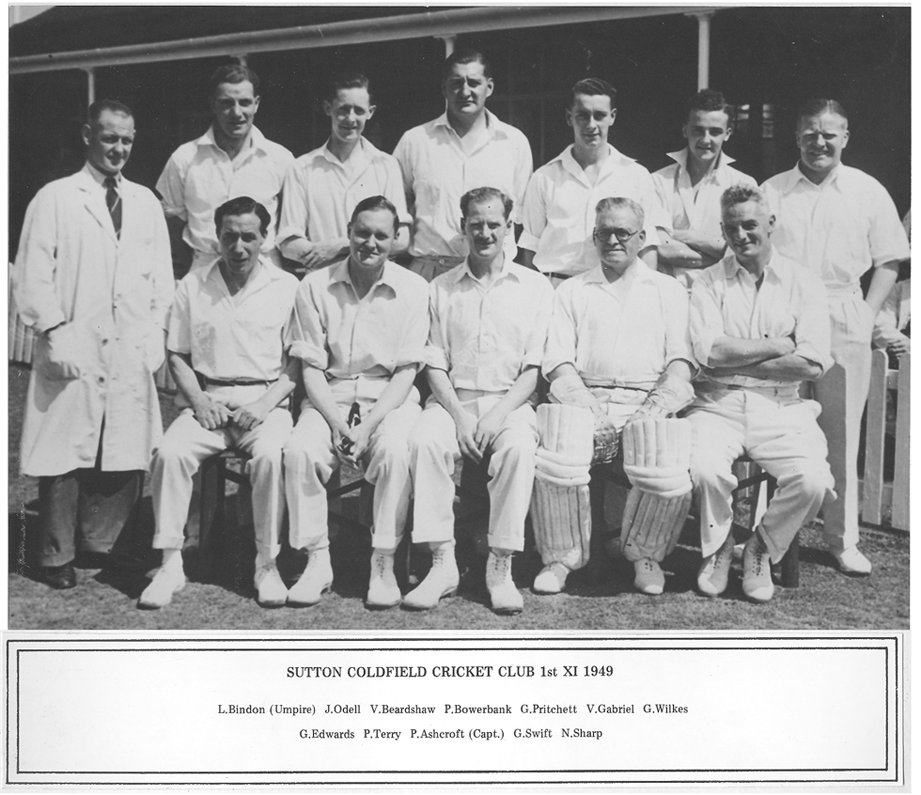
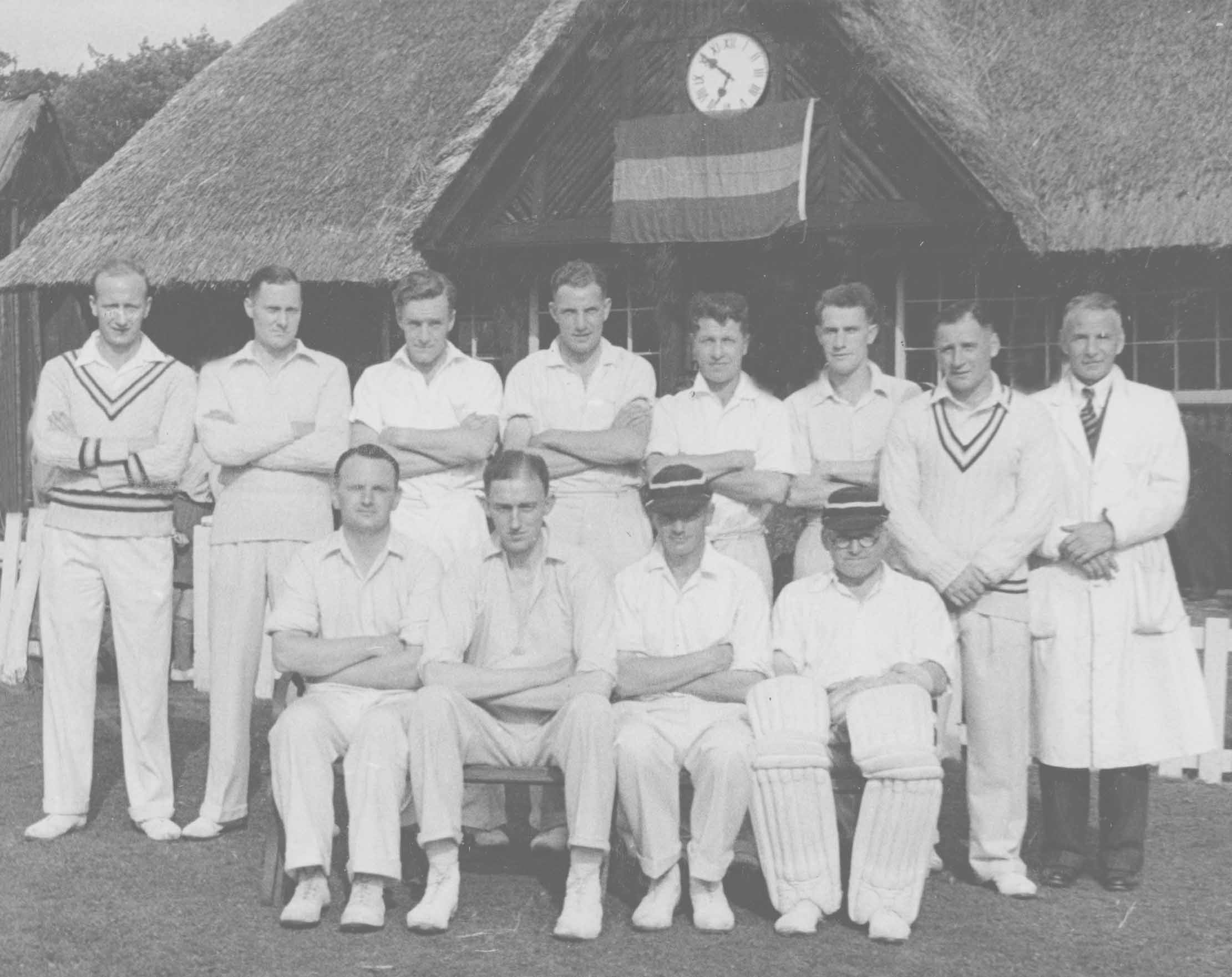
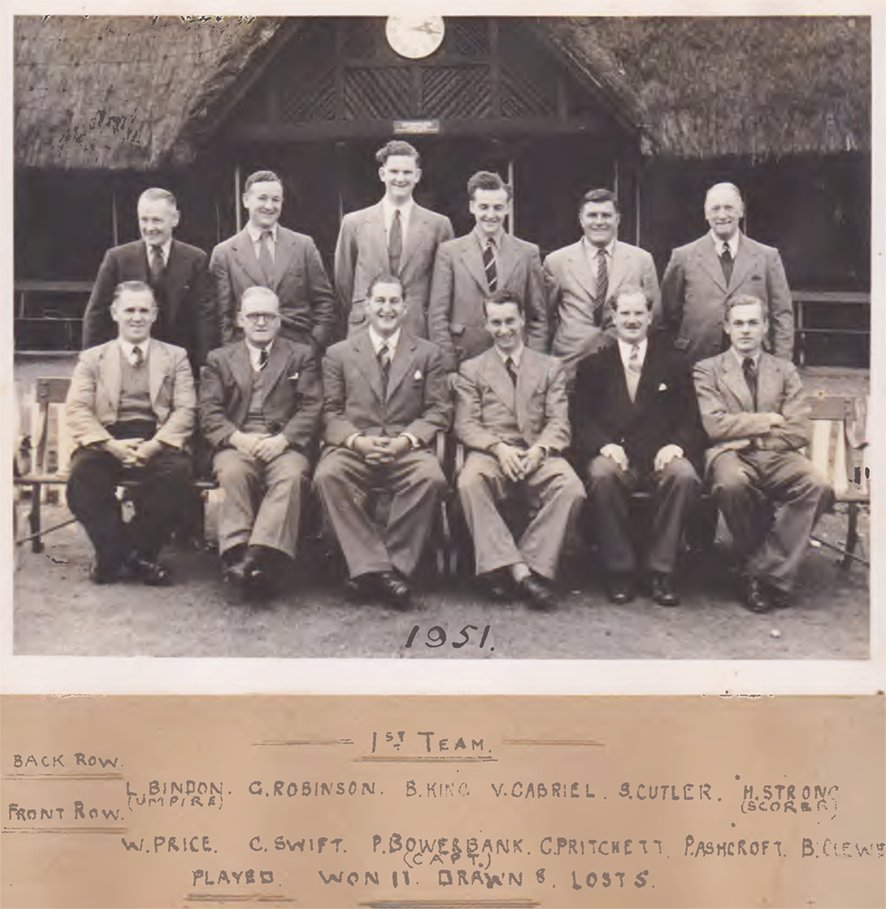
Sutton Coldfield CC, 1949 — the first season of Sunday cricket at home and of a licensed bar
A More Modern Club (1948–1949)
The early years of the Club's second century were given over to consolidation. Facilities improved gradually, but financial pressure required constant fundraising. The sudden death of President Wilfred Bigwood was a significant loss; his successor, A.E. Terry, brought continuity and a deep connection with the Club. Results did not reflect the gradual gain in playing strength — only four wins came from twenty-seven matches in 1948 and batting remained a weakness — but the bowling was consistently strong and the junior and 2nd XI ranks were growing.
The 1948 season also closed Norman Sharp's eight-year captaincy of the 1st XI. A batsman above all, he scored 19,710 runs for Sutton, 13,067 of them for the first team, and nineteen centuries, fifteen at the top level. He rarely bowled, yet against Aldridge at Rectory Park, with the visitors 50 without loss chasing 158 for 7 declared, he removed the first six batsmen in quick succession, returned to take three more and finished with 9 for 35. That year he was also among the founding members of the Midlands Club Cricket Conference.
In 1949 came two decisive breaks with tradition: Sunday cricket at Rectory Park itself, and a licensed bar — striking for a club that in the 1880s had resolved to order its beer by the crate from the Boot rather than hold a licence at all. A.H. Butler took 100 wickets in the season, a Club record. Geoff Pritchett became a first-team regular as an opening batsman, with George Swift retaining the gloves, and Peter Wells joined at seventeen straight from school, taking 6 for 11 in twelve overs for the 2nd XI at Bishop Vesey Grammar School in one of his first games.
Key Moments
1940
Cricket Continues Under War Conditions
Two teams still fielded on a local fixture list; a tie with Olton at 87 apiece and 115 not out from N. Sharp against Kings Heath.
1940
The Pre-War Officers Step Away
E.H. Walters's ten years as Hon. Secretary ended, and Frank Styles, Hon. Treasurer from 1929 to 1938, retired to Snowdonia as an Hon. Life Member.
1941
Death of George Sharp
The Club lost a servant of nearly four decades; only thirteen matches were played and Norman Sharp began eight seasons as 1st XI captain.
1942
Survival on an Overdraft of £40
The Borough Council suspended the tenancy costs and maintained the ground as travel and expenditure alike were halted.
1943–1944
Seven or Eight Members Keep Cricket Going
Paul Terry's insistence on continuing preserved the Club, with players arriving by bicycle and equipment borrowed or rationed.
1945
Peacetime Cricket Resumes
Nine wins from seventeen matches, restoration of the ground by the members themselves, and a Ferguson tractor in place of the club horse.
1946
Twenty-One-Year Lease Secured
A long lease from the Corporation, ex-army huts and the trial introduction of Sunday cricket as membership surged.
1947
The Centenary Week
A hundred years marked from 14 to 19 July with matches against the MCC, the Warwickshire Imps and the Free Foresters, founded on this ground in 1856.
1948
Norman Sharp's Captaincy Ends
Eight seasons as 1st XI captain closed; the death of President Wilfred Bigwood brought A.E. Terry to the chair.
1949
Sunday Cricket and a Licensed Bar
Home Sunday fixtures and a bar arrived together, while A.H. Butler took 100 wickets in a season — a Club record.
"He was much more than an Hon Secretary, and he was largely responsible for keeping the Club in existence. But for him, and his foresight, it is quite on the cards there may not have been a Sutton Coldfield C.C. at Rectory Park today."
Jump to New Decade
Foundations Before Formation
1837-1847
The First Fifty Years
1847-1899
A Time of Change and Uncertainty
1901-1909
A Decade of Transition and Challenge
1910-1919
The Golden Resurgence
1920-1929
The Thirties
1930-1939
Wartime and Renewal
1940-1949
The Fabulous Fifties
1950-1959
Transformation and Tradition
1960-1969
Dixon's Decade
1970-1979
Trophies and Tragedy
1980-1989
Champions at Last
1990-1999
The New Millennium
2000-2009
The Twenty-Tens
2010-2019
The Twenty-Twenties
2020-Present