
Menu
Website Design & Development
1950-1959
Seven Sides on a Saturday
Norfolk Reed, Electric Light and a Thousand Runs a Man
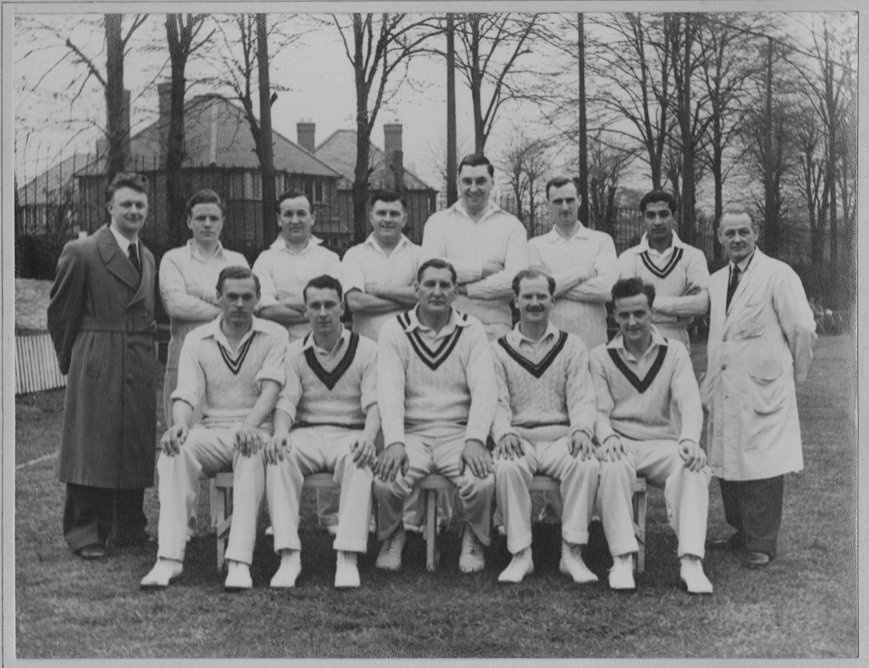
Post-War Revival, 1950-1959
The fifties were the Club's most expansive decade: up to seven sides in the field on a summer weekend, five men past a thousand runs in a single season, and a thatched pavilion re-roofed in Norfolk reed and wired for electricity for the first time.
Sutton came out of austerity growing. A Sunday third team arrived in 1953, the Annual Dinner was revived after some fifty years, and twenty-four new members — most of them young — joined in 1954 as the Club's selection and development policy took hold. None of this was league cricket: Sutton played the friendly fixture list it had guarded for a century, declining invitations to the Birmingham League as it always had, and measured itself instead by aggregates, averages and the calibre of its visitors, who in these years included Warwickshire themselves before a crowd of some three thousand. Behind it stood a small group of remarkable cricketers — P.E.S. Bowerbank, captain for eight seasons; Geoff Pritchett, twice past a thousand runs; Les Pellow, twice past a hundred wickets; Peter Yates and his left-arm swing — and, arriving quietly in 1955, a young batsman and off-spinner named Neil Houghton.
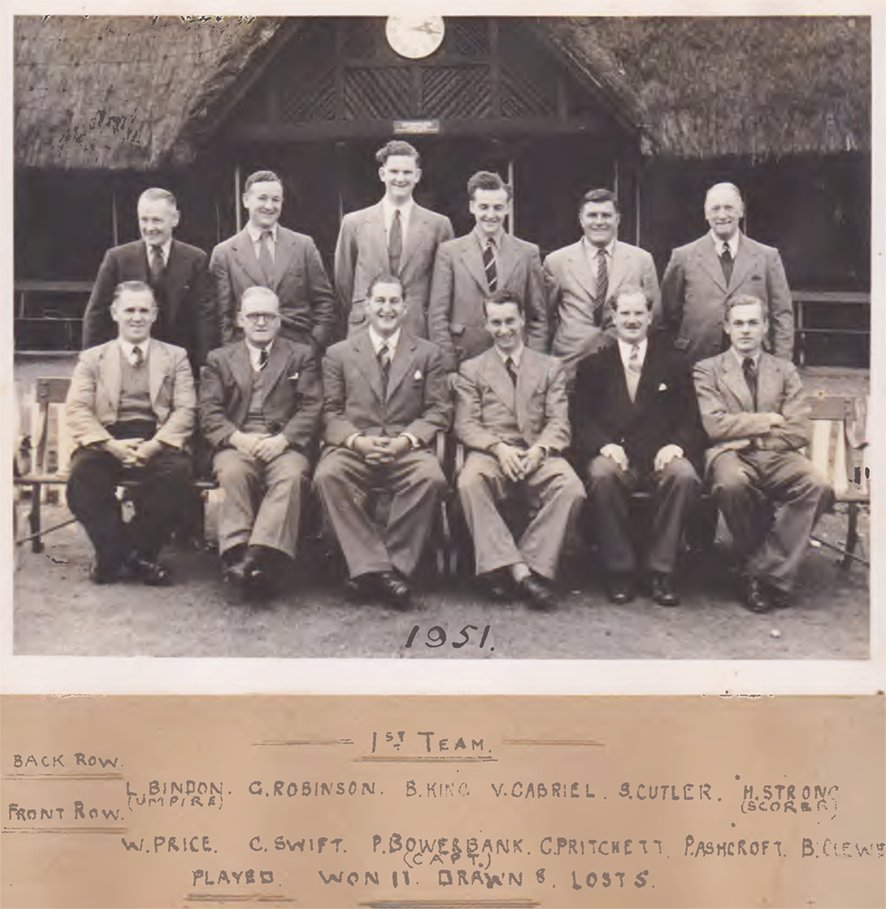
Sutton Coldfield CC, 1951 — Festival of Britain winners under P.E.S. Bowerbank
A Club of Seven Sides (1950–1953)
By 1950 the Club had moved out of recovery and into organisation, with a full officer structure and Sunday fixtures introduced for the 2nd XI. It lost L.W. Stevenson, a mainstay of the wartime and rebuilding years, whose relocation left a gap in both playing strength and leadership. Rectory Park itself was adapting to the motor car: where the approach had been a footpath from Riland Road and another opposite Good Hope Hospital, a top gate now served the ground, manned by small boys from Boot Hill who carried the visitors' bags for a few coppers — one penny among a dozen of them buying a bagful of buns from Bromwich's.
1951 was the turning point on the field. Under P.E.S. Bowerbank the 1st XI won eleven of twenty-four matches and carried off the Festival of Britain competition, the captain himself scoring 1,184 runs and taking 59 wickets. A new toilet block was built for £150, W. Harry Foster donated a scorebox, and the arrival of L. Pellow strengthened the attack for years to come.
Growth accelerated. In 1952 Paul Terry stepped down as Hon. Secretary and was elected a Life Member for his wartime service; the bar was expanded into both a social hub and a source of income, and the seventeen-year-old D. Haworth took 100 wickets. The following season the Annual Dinner was revived after some fifty years and a Sunday 3rd XI introduced, so that Sutton was fielding up to seven sides on a weekend — 56 wins from 117 matches, five players past a thousand runs, and a new groundsman, Alex Harvey, beginning eighteen years of service.
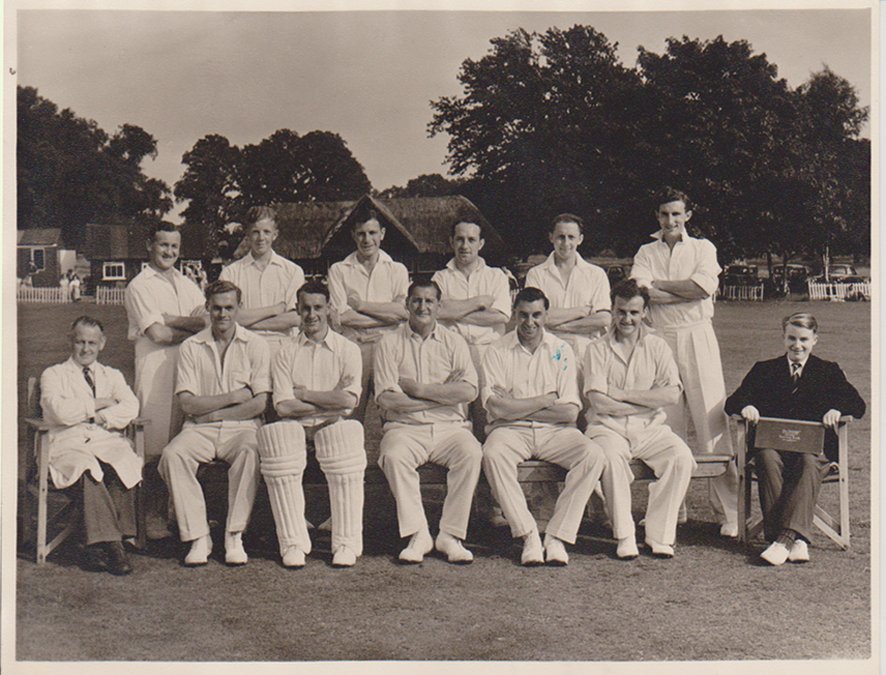
The side of 1953, the season Geoff Pritchett scored 1,280 runs and five Sutton players passed a thousand
Runs by the Thousand
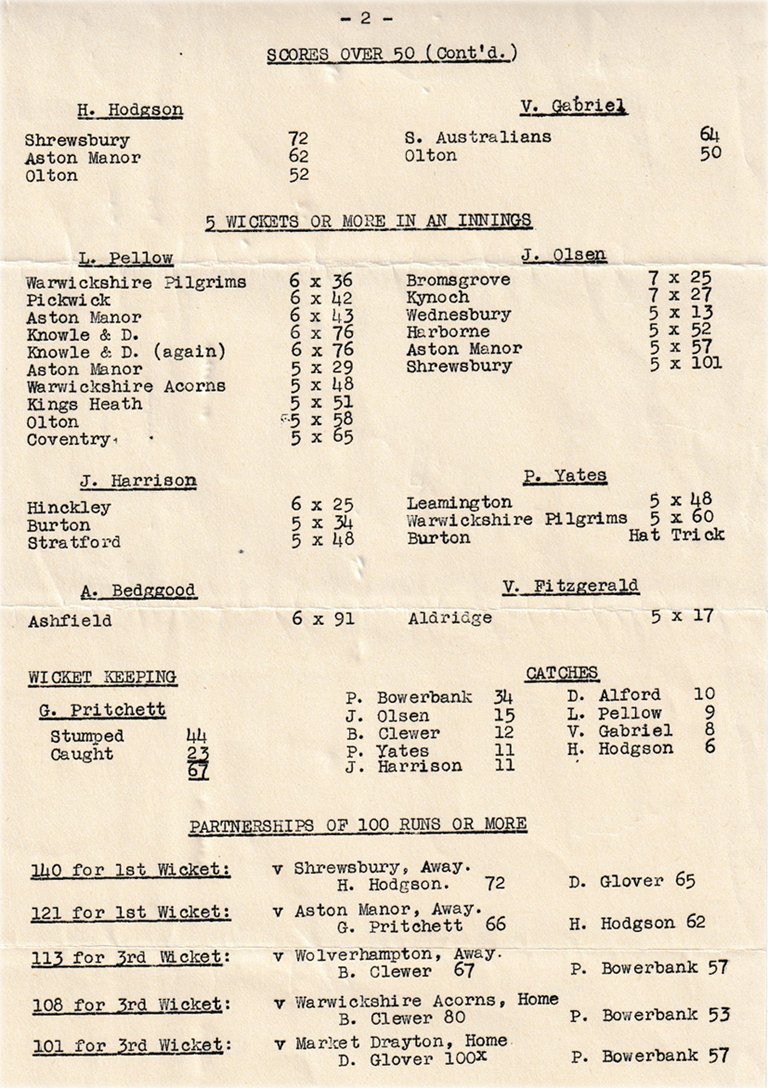
Geoff Pritchett had joined in 1947 as a wicketkeeper-batsman but spent seven seasons out of the gloves behind George Swift. He made his name with the bat instead: 1,280 runs in 1953 — 914 on Saturdays and 366 on Sundays — with 106 at home to Leamington, then 113 not out at Market Drayton in 1954, 114 not out at Ashfield in 1956, 1,072 runs in 1957 and 118 against the Warwickshire Pilgrims in 1959. When Swift retired in 1954 the gloves finally came to him, and the Club's accounts of his hauls behind the stumps in the middle fifties differ, one itemising 52, 69 and 67 victims in successive seasons and another totalling 189 across them.
Others matched him. Bowerbank's 1955 season brought 1,445 runs at an average of fifty, while Les Pellow passed a hundred wickets in the same summer. Peter Yates, a left-arm medium-fast swing bowler who moved the ball both ways, led the Club's bowling in 1956 with 39 wickets at 13.7 and again in 1957 with 37 at 16.3; his best season with the bat came in 1955, 343 runs at 17.1 with a highest score of 50 not out.
The Club also began to look after its future. The revised selection and development policy brought in twenty-four new members in 1954, most of them young, and a structured junior coaching scheme followed in 1959. That season Brian Clewer, newly appointed captain, set a Club record for runs in a season — the surviving accounts give different totals — and shared a record partnership of 217 with Eardley.
Rectory Park, 1956 — the year electricity came to the ground and the lower sides became the Hawks, Owls and Grasshoppers
Norfolk Reed and Electric Light
A surplus of £200 in 1955 let the Club attend to the fabric of the place. The pavilion roof was re-thatched in Norfolk reed as a long-term solution, and the water supply and ground facilities were upgraded at the same time — modest works, but the first real investment in the buildings since before the war.
1956 went further. Structural alterations and new full-length windows transformed the pavilion, the work driven largely by the dedication of Frank Lamb and by the voluntary effort that had underpinned everything since 1945. Electricity was installed at the ground for the first time, a £330 project long overdue, and the lower elevens were renamed the Hawks, the Owls and the Grasshoppers — a change of nomenclature that deliberately raised the standing of the Club's developing sides.
Money followed the improvements. The bar was improved again in 1958 and returned profits of more than £230, rising to £331 the following year, and a match levy was introduced to steady the income. Discussions were opened with the Borough Council about renewing the lease and improving the ground, while successful dinners, visiting touring sides and the increasingly recognised work of the Club's ladies kept both the finances and the social life in good order.
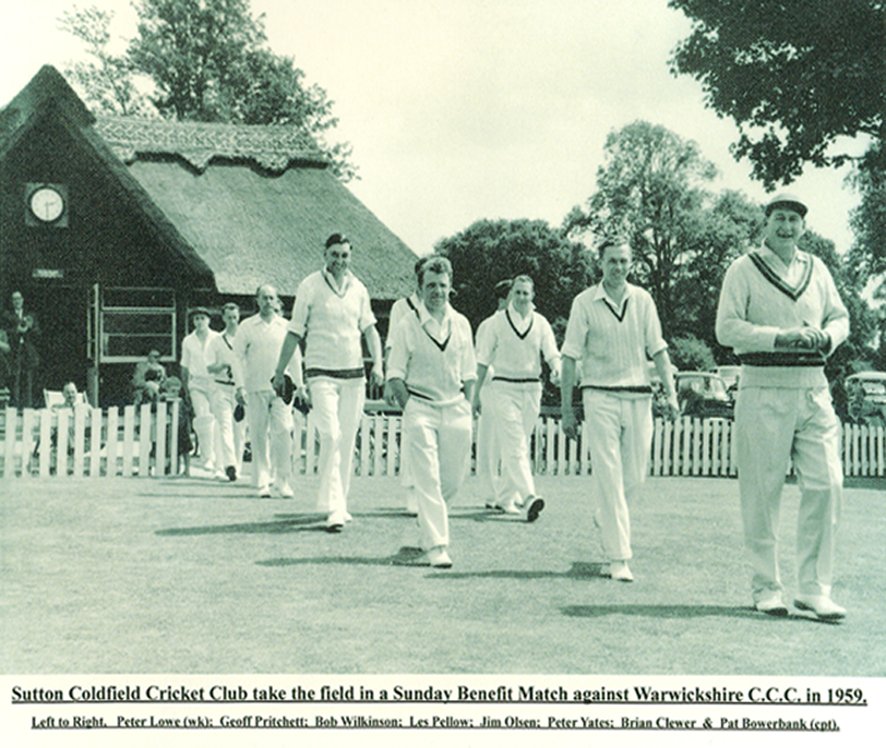
Sutton Coldfield CC, 1959 — Brian Clewer's first season as captain, and a record aggregate of runs
Big Days and Farewells
Sutton's standing brought good visitors. The match against Warwickshire in 1955 drew a crowd of some three thousand and raised significant funds; a touring South Australian side was beaten in 1956; and in 1957 the Suez Crisis and the threat of petrol rationing briefly menaced the fixture list before the situation resolved ahead of the season.
The showpiece came in 1957, when the county returned for Dick Spooner's benefit year. The match raised £188, Warwickshire made 281 for 8, and Sutton's reply was undone by the flight and spin of Eric Hollies. In the same summer G.B. Thompson was confirmed as Hon. Secretary, Roger Coombs came back from National Service to play his cricket in the 2nd XI, and that youthful side recorded a record number of victories.
1958 brought the decade's heaviest loss: the death of Eric Bertram "Tom" Crockford, who had played for Sutton and for Warwickshire between 1911 and 1922, won hockey gold at the 1920 Antwerp Olympics for Great Britain and Ireland, represented England seventeen times and held records for the highest billiards break. Despite poor weather the 1st XI won sixteen matches, three hat-tricks fell in a single weekend — one of them Peter Wells's against Pickwick Nomads — and Peter Lowe took over the gloves. A year later Bowerbank retired after eight seasons as captain, and Brian Clewer succeeded him.
Key Moments
1950
The Top Gate and the Gate Boys
A top gate replaced the old footpath approaches for the motoring age, manned by boys from Boot Hill who carried the visitors' bags for coppers.
1951
Festival of Britain Winners
Eleven wins from twenty-four under P.E.S. Bowerbank, who scored 1,184 runs and took 59 wickets; a new toilet block and a donated scorebox followed.
1952
Paul Terry Elected a Life Member
The wartime Hon. Secretary was honoured on his retirement from office; the seventeen-year-old D. Haworth took 100 wickets.
1953
Seven Sides and Five Thousands
A Sunday 3rd XI took the Club to seven sides on a weekend; 56 wins from 117 matches and Geoff Pritchett's 1,280 runs led the way.
1954
Pritchett Takes the Gloves
George Swift's retirement made Pritchett the 1st XI wicketkeeper at last, in a season in which 41 matches were lost to the weather.
1955
Norfolk Reed and 1,445 Runs
A £200 surplus re-thatched the pavilion and Warwickshire's visit drew some three thousand people; Bowerbank scored 1,445 runs at fifty, Les Pellow took 102 wickets and Neil Houghton joined the Club.
1956
Electricity Installed
A £330 project finally brought electric light to the ground; the lower elevens were renamed the Hawks, Owls and Grasshoppers.
1957
The Spooner Benefit Match
Warwickshire made 281 for 8 in aid of Dick Spooner's benefit, raising £188, with Sutton's reply undone by Eric Hollies.
1958
The Passing of Tom Crockford
The death of E.B. Crockford, Warwickshire cricketer, 1920 Olympic hockey gold medallist and billiards record-holder.
1959
Bowerbank Hands Over
Eight years as captain ended; Brian Clewer succeeded him and set a new Club record for runs in a season.
"Get your kit on, you are playing."
Jump to New Decade
Foundations Before Formation
1837-1847
The First Fifty Years
1847-1899
A Time of Change and Uncertainty
1901-1909
A Decade of Transition and Challenge
1910-1919
The Golden Resurgence
1920-1929
The Thirties
1930-1939
Wartime and Renewal
1940-1949
The Fabulous Fifties
1950-1959
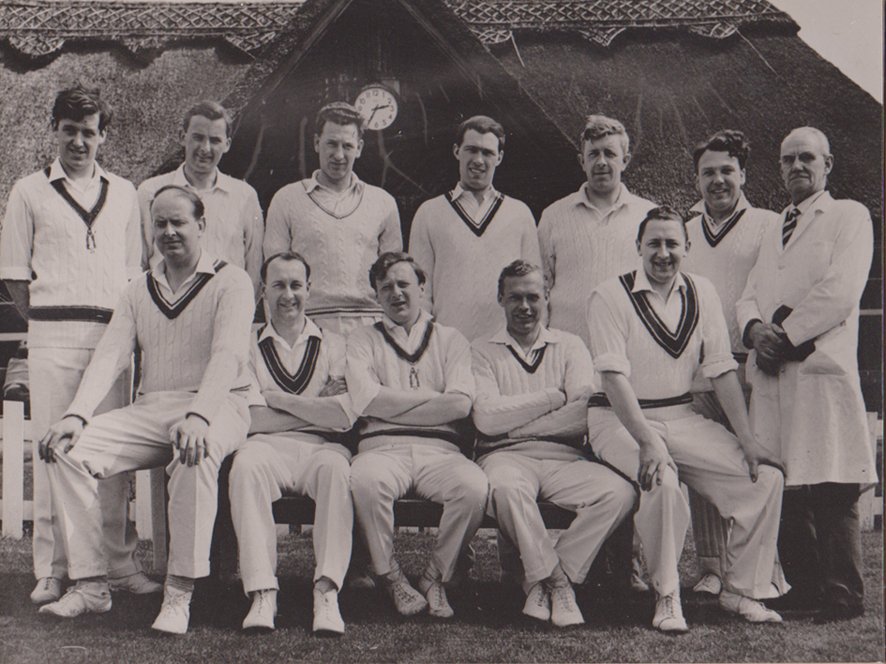
Transformation and Tradition
1960-1969
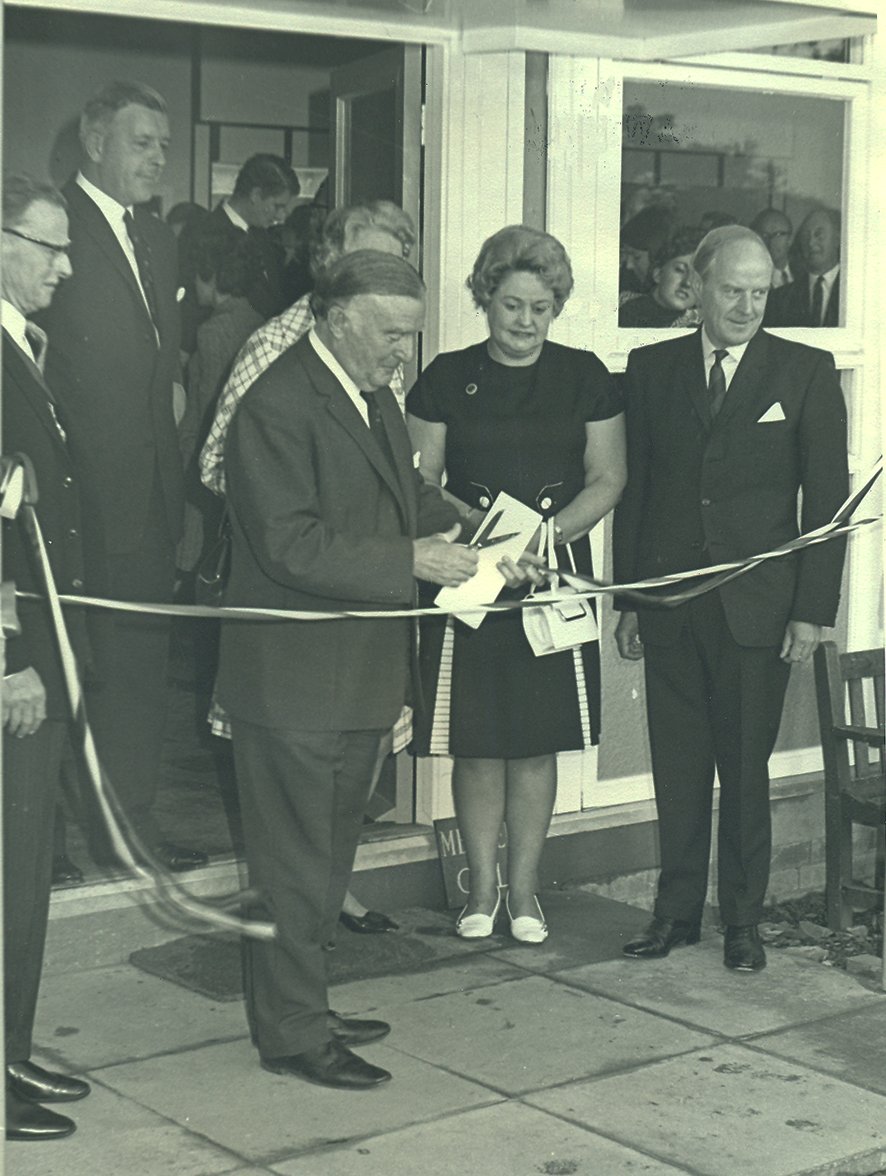
Dixon's Decade
1970-1979
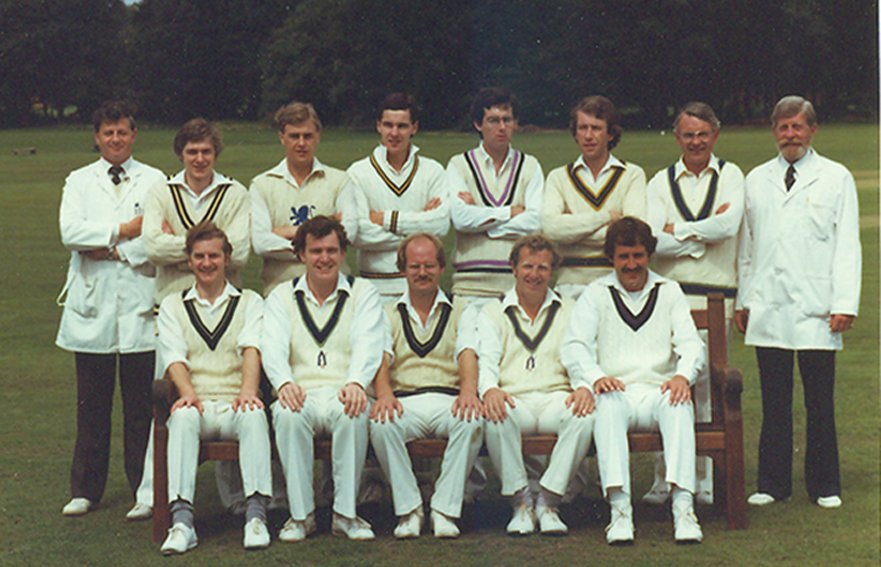
Trophies and Tragedy
1980-1989
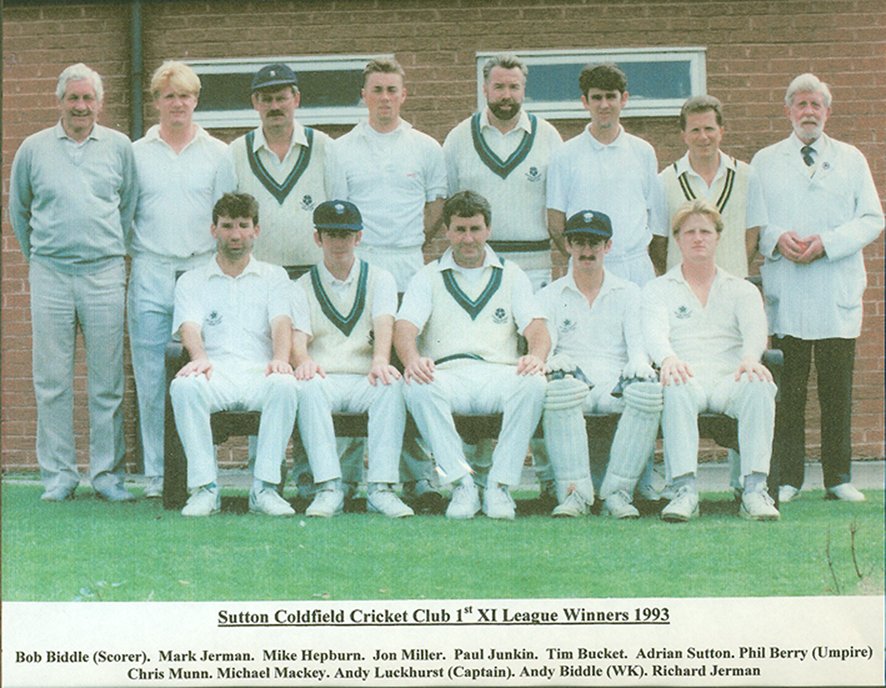
Champions at Last
1990-1999
The New Millennium
2000-2009
The Twenty-Tens
2010-2019
The Twenty-Twenties
2020-Present