Menu
Website Design & Development
1960-1969
Forty-Four Matches, Fourteen Men
The Club at Its Height, and the Burning of the Old Pavilion
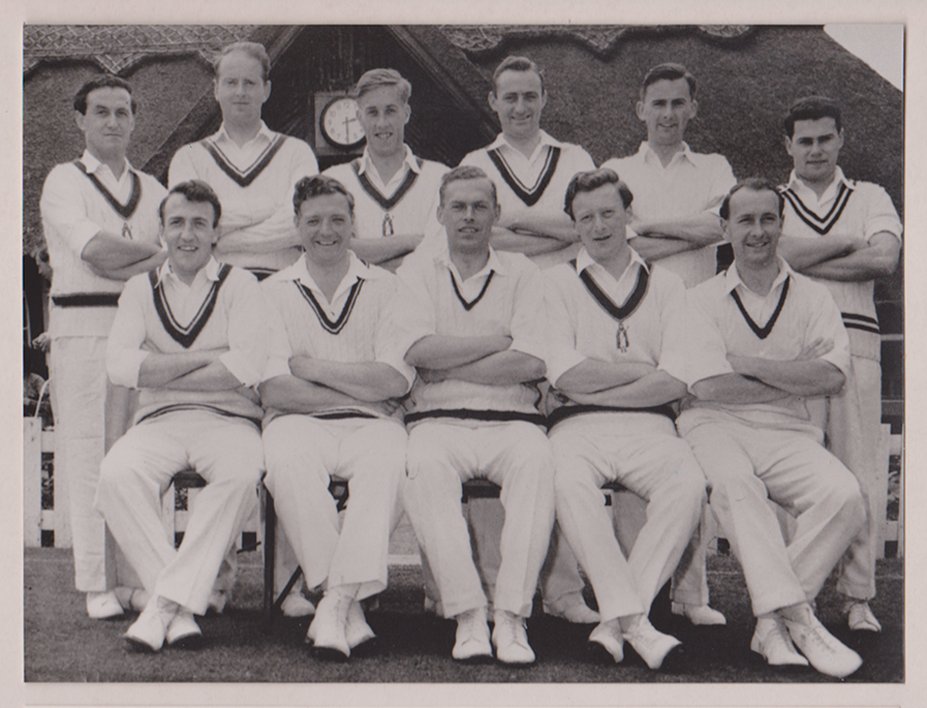
The Swinging Sixties, 1960-1969
In 1962 Sutton counted 351 members and fielded sides at every level; by 1965 it was struggling to raise the lower elevens. The decade carried the Club from its highest point to a hard reckoning, and ended with the old thatched pavilion burning down the day before the demolition men were due.
The sixties are unusually well recorded at Rectory Park, partly because the fixture cards survive with their membership tables printed inside — a President, three Life Members, seventy-odd Vice Presidents and well over a hundred non-playing members supporting a playing strength that peaked at 107 in 1963 — and partly because Neil Houghton, captain from that season, left a first-hand account of what the cricket was actually like. It was non-league cricket, as it had been for more than a century: no points, only the toss, matches regulated by the pavilion clock from half past two until a quarter to eight, and a declaration expected at five o'clock. It was also cricket of a high standard, producing a record run of ten straight victories in 1960, a wicket-keeping record in 1961 that stood for more than fifty years, and in 1969 the most successful first-team season the Club had ever had.
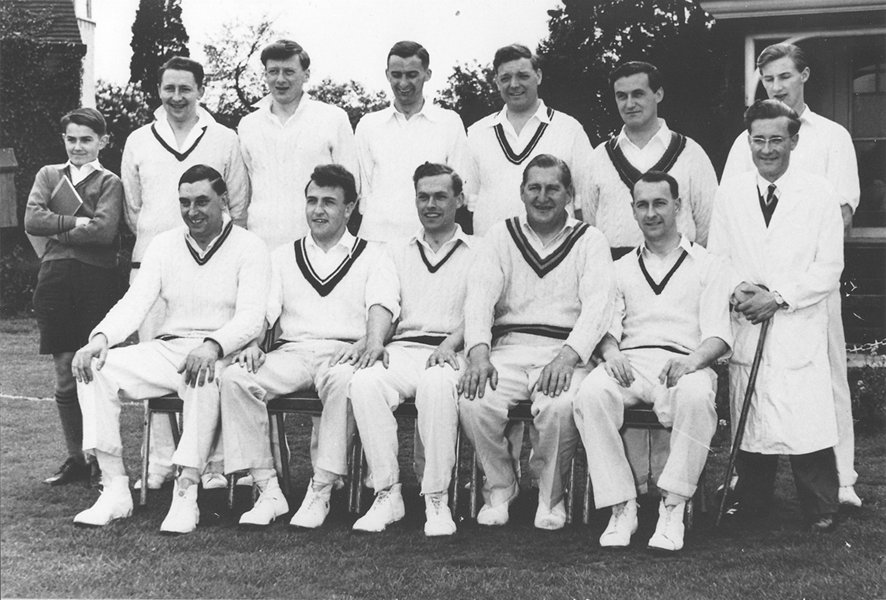
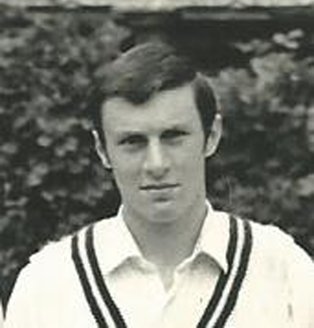
The 1st XI of 1960, winners of ten consecutive matches — a Club record
The Club at Its Height (1960–1962)
1960 opened with major work on the lower ground pavilion, an £800 project helped by a £400 grant from the Supporters' Association of Warwickshire C.C.C., secured largely through the influence of W. Leslie Jones. The 1st XI put together a record run of ten consecutive victories with Neil Houghton and Brian Clewer to the fore; Geoff Pritchett fell one run short of a hundred at Leicester Ivanhoe, and Roger Coombs headed the 2nd XI batting with 657 runs. The deaths of R.S. Hill and Jack Frisby cast a long shadow over the year. The season's fixture card recorded 78 Vice Presidents, 72 playing and 124 non-playing members — 278 in all.
1961 may have been the Club's strongest season in its history. Membership rose to 335, the long hoodoo against Coventry & North Warwickshire was finally broken, and the Festival Shield came to Rectory Park. Neil Houghton was elected Cricketer of the Year by the Midland Club Cricket Conference. Behind the stumps Roger Coombs claimed 76 victims, a Club record still standing more than fifty years later, and headed the 2nd XI batting with 619 runs besides — the latest in a line of keepers of whom it was said that for fifty years Sutton had possessed wicketkeepers of the highest class in club cricket.
Membership peaked in 1962 at 351 — 83 Vice Presidents, 97 playing and 167 non-playing members. The 2nd XI won a record 29 matches, D. Drake took 116 wickets, and Geoff Pritchett scored 821 runs in what proved his fifteenth and final season in the 1st XI. Norman Sharp stepped down after six years as chairman and was elected President of the Midland Club Cricket Conference. Lower down, John Ratledge's Owls played twenty games, won twelve and lost two, with eight lost to the weather and not a single drawn game recorded.
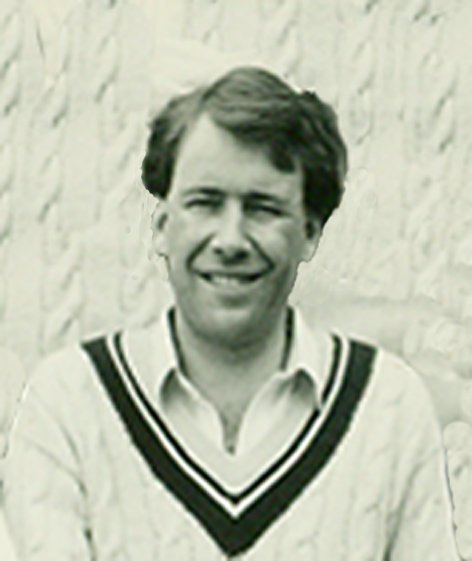
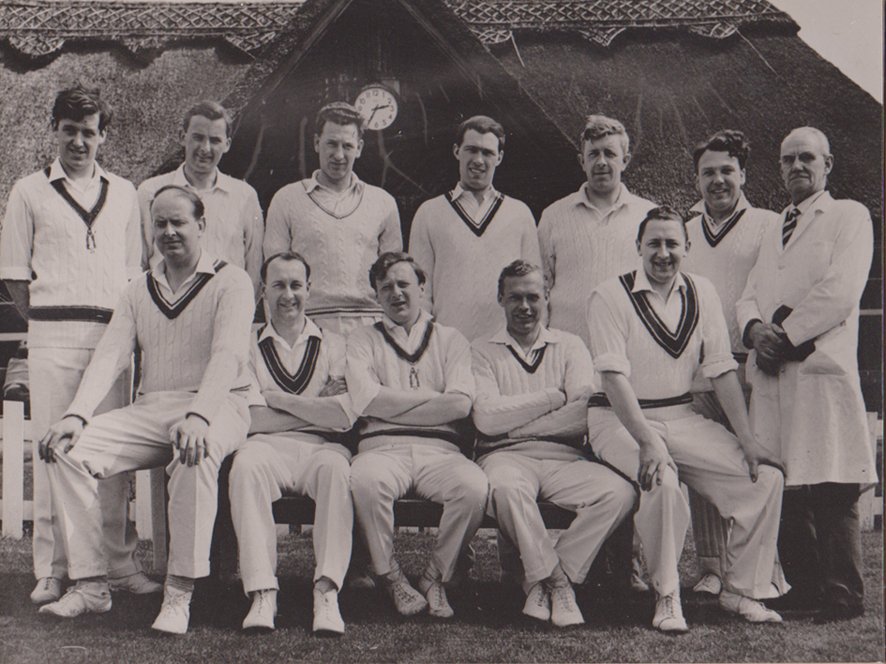
Sutton Coldfield CC in 1963 — a season played by only fourteen men across forty-four matches
Forty-Four Matches and Fourteen Men (1963)
1963 was Neil Houghton's first year as Club Captain, at twenty-four and with his final examinations due at the end of the season — a combination, he later admitted, that his parents did not think a good idea. The Club played 44 matches that summer, winning 20, drawing 12, losing 10 and having two abandoned. Looking back at the season's averages, only fourteen players featured in them: most 1st XI men played both Saturdays and Sundays, and competition for places favoured those available on both days.
Two arrivals transformed the side. Martin Bloomer came from Streetly, made 281 runs in about four games for the 2nd XI, was promoted and quickly replaced Geoff Pritchett as opening batsman, finishing the year with a thousand runs for the 1st XI and an aggregate of 1,300 for the Club, including 109 not out at home to Bromsgrove. Andrew "Chub" Beach took 94 wickets in his first season — 90 of them in the 2nd XI, 40 stumped by his friend Roger Coombs — and, given two games in the first team, took 5 for 13.
There was fine bowling elsewhere too: Peter Wells produced 6 for 14 in sixteen overs against Leicester Ivanhoe at Rectory Park, the outstanding performance of his career. For the older generation the season marked a handing-on. Pritchett moved to the 2nd XI after 1963, and Peter Yates played mainly in the second team that year, while John Ratledge was elected captain of the Hawks, a post he held for three seasons.
The old thatched pavilion and its clock, which governed every match from half past two until a quarter to eight
By the Pavilion Clock
All the Club's fixtures were non-league, but they were fiercely competitive with Sutton's reputation at stake. The strongest clubs of the circuit — Coventry & N.W., Olton, Knowle and Dorridge, Wolverhampton, Leamington, Harborne, Stratford, Moseley Ashfield and Kings Heath — came year after year. There were no points to contend with, only winning or losing the toss. Matches were regulated by time, starting at 2.30pm and finishing at 7.45pm, so the large pavilion clock played a major role; the requirement to bowl twenty overs in the last hour had not yet been introduced.
Convention did the rest. The captain of the side batting first would normally declare at five o'clock unless he had been bowled out first. Late declarations were frowned upon and in extreme cases led to questions in the bar afterwards about the suitability of future fixtures — hence the expression "drinking the fixture back". Fielding flannels had to be dry-cleaned, which made grass stains expensive.
The setting was more charming than comfortable. The old thatched pavilion had its charms, but the small changing hut beside it, with one small basin and no hot water or showers, was certainly a challenge. The Club was supported by more than seventy Vice Presidents and over 160 non-playing members; local residents watched from cars parked along the top boundary fence, and one of the captain's match-day duties was to appoint two players to take the collection box round the ground while Sutton batted. Midweek there was the Festival Shield, a twenty-over knock-out for sixteen Sutton and district clubs — Streetly, Walmley, Four Oaks, Water Orton, Wishaw, the Hockey Club and Old Veseyans among them — played on Tuesday and Thursday evenings and drawing good support, especially in the bar.
Rectory Park in 1966, the year Norman Sharp succeeded Alderman A.E. Terry as President
Fewer Players, Bigger Plans (1964–1967)
Negotiations with the Borough Council produced a favourable extension of the lease in 1964, and with the ground secured the Club turned to its buildings. Norman Sharp recorded that the pavilion "was considered to have a limited life left and that the time was ripe to go ahead with plans for a more modern building", and a sub-committee was appointed to review the prospects — the Club's own accounts differ as to whether this was in 1963 or 1964. It comprised the Hon. Secretary G.B. Thompson, D. Alford as quantity surveyor, L.O. Tippins as architect, D.P. Locker as solicitor, the captain W.N. Houghton and J.W. Ratledge, who brought a businessman's approach to the work. Its plans were approved unanimously at a General Meeting.
On the field Martin Bloomer passed a thousand runs for three consecutive seasons — 1,204 in 1964 with 101 not out at Coventry & N.W., 1,154 in 1965 with 103 at home to Moseley Ashfield, and 113 against Little Aston Stragglers in 1966 — and Neil Houghton achieved the rare all-round double in 1964. But playing membership was falling, particularly in the lower teams, and Norman Sharp's analysis of selection policy and of the abandonment of the 1952 development system made uncomfortable reading. One gain of 1965 was accidental: during a Bank Holiday tea interval Houghton fell into conversation with a spectator named Peter Bell and invited him to join, and Bell umpired the rest of that afternoon with the Hawks and stayed for the next fifty years.
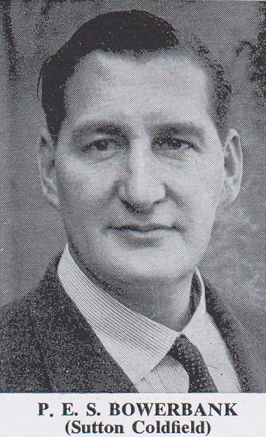
1966 brought the largest administrative change in a generation. Alderman A.E. Terry, a member since 1914 and President since 1950, retired at ninety — the first President in the Club's history to relinquish office voluntarily — and Norman Sharp, whose association with Sutton ran back to 1905, succeeded him. G.B. Thompson and R.H. Smith retired after ten and nine years as Hon. Secretary and Hon. Treasurer, C.T. Groves and Geoff Pritchett taking their places, though the Club's accounts differ over exactly when Pritchett's decade as treasurer ended. On World Cup final day, 30 July, Houghton brought a television to the ground so that players could watch — then batted all afternoon and saw none of the match.
1967 was a year of weather and negotiation. The press called May the wettest in 190 years and nineteen fixtures were lost in the month alone; the 1st XI managed nine wins from thirty-nine matches, and a remarkable tie against the Old Edwardians ended with the last batsman run out on 140 apiece. The new office of Chairman of the Club was created and H.A. Couchman elected to it, only for him to die suddenly in June. Protracted talks with Sutton Coldfield R.F.C. about sharing a new pavilion collapsed over a demand for £25,000, and a fresh approach was made instead to the Hockey Club.
Amalgamation, Triumph and Fire (1968–1969)
The amalgamation of the Cricket and Hockey Clubs was formally confirmed in April 1968, with Norman Sharp elected President of the new Association, Charles Groves Hon. Secretary and H. Ford Hon. Treasurer. A Building sub-committee then submitted plans for a pavilion costing a little over £11,000, to be erected by Lessar Bros. Ltd with six dressing rooms, a club room and the usual amenities; the membership approved them unanimously. The Town Council extended the lease by a further seven years to twenty-eight in total, a £500 grant — the maximum available — came from the Midlands C.C.C., and with the "120 Club" and the hockey club's contribution some £9,000 was already in hand.
The cricket of 1968 was played in wretched weather, every 1st XI Saturday fixture being rained off, yet Neil Houghton produced the rare feat of a century and a hat-trick in the same match against Walsall, Michael Dixon made 183 not out for the Hawks, Martin Bloomer scored 623 runs and Peter Wells took 6 for 7 for the 2nd XI at Bromsgrove. The Annual Dance returned a record £234 profit on the back of the "120 Club" Mini draw, won by Mrs L. Balmer.
Then, under Martin Bloomer's captaincy, came the best season the 1st XI had ever had: twenty-three victories in 1969. Tony Robertson, an attacking batsman who made a century and a 96 not out on the same weekend, and T. Jameson, brother of the Warwickshire player, both strengthened the side, while Jamie McDowall kept wicket and opened the batting for Cambridge University. Sutton entered the new Derrick Robins national knock-out for the first time and went out at Lichfield in torrential rain and complete darkness.
The year's dominant event was not a cricketing one. With the appeal funded and the new pavilion agreed, the old building was stripped and contractors moved on site in early November. The day before demolition a spark from a workmen's brazier set the thatch alight and gutted the pavilion completely. The groundsman Alex Harvey was inside at the time and came to no harm, and the insurers paid out — but the building that had governed the Club's afternoons by its clock for eighty years was gone twenty-four hours before it was due to come down.
Key Moments
1960
Ten Consecutive Victories
A record winning run for the 1st XI, in a season whose fixture card recorded 278 members in all.
1961
Seventy-Six Victims
Roger Coombs set a Club wicket-keeping record that still stood more than fifty years later; Neil Houghton was Midland Club Cricket Conference Cricketer of the Year and the Festival Shield was won.
1962
Membership at Its Peak
351 members recorded on the fixture card, the 2nd XI won a record 29 matches, and Geoff Pritchett closed his fifteenth and final 1st XI season with 821 runs.
1963
Neil Houghton Takes the Captaincy
Aged 24 and with final examinations pending, he led a side that played 44 matches — 20 won, 12 drawn, 10 lost, 2 abandoned — using only fourteen players.
1963
Bloomer and Beach Arrive
Martin Bloomer scored 1,300 runs for the Club in his first season and Andrew "Chub" Beach took 94 wickets in his.
1964
Lease Extended, Pavilion Considered
The Borough Council extended the lease and a sub-committee was appointed to plan a modern pavilion; the Club's records differ over whether it was formed in 1963 or 1964.
1966
A Changing of the Guard
Alderman A.E. Terry retired as President at ninety and Norman Sharp succeeded him, with new Hon. Secretary and Hon. Treasurer appointed the same year.
1967
The Wettest May in 190 Years
Nineteen fixtures were lost in the month; H.A. Couchman, first Chairman of the Club, died weeks after election, and talks with the Hockey Club began.
1968
Amalgamation Confirmed
Cricket and hockey formally amalgamated in April and an £11,000 pavilion was approved; Neil Houghton made a century and took a hat-trick in the same match against Walsall.
1969
Best Season, and the Fire
Twenty-three wins under Martin Bloomer — the most successful 1st XI season on record — and the old thatched pavilion destroyed by fire the day before its scheduled demolition.
"The old thatched pavilion had its charms but the small changing hut by the side with one small basin and no hot water or showers was certainly a challenge."
Jump to New Decade
Foundations Before Formation
1837-1847
The First Fifty Years
1847-1899
A Time of Change and Uncertainty
1901-1909
A Decade of Transition and Challenge
1910-1919
The Golden Resurgence
1920-1929
The Thirties
1930-1939
Wartime and Renewal
1940-1949
The Fabulous Fifties
1950-1959
Transformation and Tradition
1960-1969
Dixon's Decade
1970-1979
Trophies and Tragedy
1980-1989
Champions at Last
1990-1999
The New Millennium
2000-2009
The Twenty-Tens
2010-2019
The Twenty-Twenties
2020-Present